
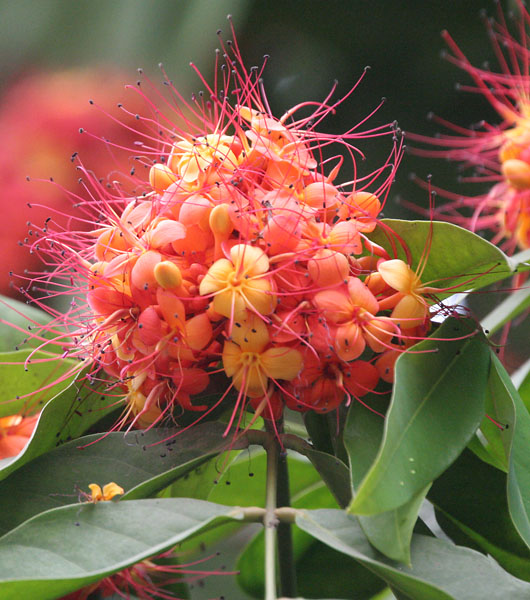
Ashoka Tree (Saraca asoca / Saraca indica)
The Ashoka tree (Saraca asoca), traditionally associated with freedom from sorrow, is a sacred and culturally significant tree in India. It holds an important place in Ayurveda, Hindu mythology, Buddhist traditions, and ancient Indian art. Beyond its botanical identity, the Ashoka tree symbolizes hope, emotional resilience, feminine energy, and spiritual well-being.
- Botanical Profile: Scientific Understanding
Scientific Name: Saraca asoca (often incorrectly identified as Saraca indica)
Family: Fabaceae (Legume family)
Morphology
- Type: Evergreen, medium-sized tree, generally growing 6–10 metres tall.
- Leaves: Compound leaves with a glossy green appearance. Young leaves often emerge in a copper-red colour, traditionally described as Tamra Pallava.
- Flowers: Flowers grow in dense clusters and change from yellow-orange to deep red as they mature. The flowering season is generally February to April.
- Fruits: Flat pods containing seeds.
- Habitat: Tropical forests and riverbanks, particularly in parts of the Western and Eastern Ghats and sub-Himalayan regions.
Special Note: Ashoka vs. False Ashoka
The true Ashoka tree (Saraca asoca) is often confused with False Ashoka (Polyalthia longifolia), a commonly planted ornamental tree. Although both are used in landscaping, they are botanically different species. Traditional medicinal uses attributed to the true Ashoka should not automatically be applied to False Ashoka.
- Sanskrit Names and Their Meanings
The traditional name of the Ashoka tree reflects its association with the relief of sorrow and emotional well-being.
Important Sanskrit Names
- अशोक (Ashoka): Commonly interpreted as “without sorrow” or “one that removes sorrow.” The name is derived from a (without) and shoka (sorrow).
- कंकली (Kankeli): A traditional name associated with the Ashoka tree.
- ताम्रपल्लव (Tamra Pallava): Meaning “copper-coloured tender leaves,” referring to the distinctive reddish appearance of young leaves.
- हेमपुष्प (Hemapushpa): Meaning “golden flowers,” referring to the tree’s yellow-orange blossoms.
The name Ashoka carries botanical, cultural, emotional, and spiritual associations that have contributed to the tree’s enduring importance in Indian traditions.
- Mythological and Cultural Significance
Ashoka Vatika in the Ramayana
In the Ramayana tradition, Goddess Sita was held in Ashoka Vatika in Lanka during her captivity. The garden’s association with Sita has made the Ashoka tree a symbol of endurance, hope, and inner strength in the face of adversity.
The symbolism is especially meaningful: even during periods of grief and uncertainty, hope and dignity can endure.
Connection with Kamadeva, the God of Love
In traditional Indian literature and mythology, the Ashoka flower is associated with Kamadeva, the god of love, and is included among the five floral arrows attributed to him in certain traditions.
The Ashoka flower is consequently associated with:
- Love and affection
- Emotional sensitivity
- Romantic awakening
- The awakening of the heart
Buddhist Connection
The Ashoka tree also appears in Buddhist cultural traditions. Some accounts associate Queen Maya’s encounter with a tree branch with the birth of Siddhartha Gautama, the Buddha. The specific tree and details vary across traditional accounts.
The tree’s association with sacred birth narratives has contributed to its importance in South Asian religious and cultural heritage.
Yakshi Symbolism in Ancient Art
In ancient Indian sculpture, Yakshi figures are sometimes depicted holding or standing beside flowering branches, including Ashoka branches.
These images are associated with:
- Fertility and abundance
- Feminine creative power
- Nature and renewal
- Prosperity and vitality
- Esoteric and Energetic Understanding
In traditional spiritual interpretations, the Ashoka tree is understood not merely as a plant but also as a symbol of emotional transformation, harmony, and inner balance.
Core Energetic Qualities
Within these interpretations, the Ashoka tree is associated with:
- Relief from Shoka: Symbolically representing the release of grief and emotional heaviness.
- Anahata Chakra: Associated with the heart centre, compassion, love, and emotional openness.
- Shakti: Symbolizing feminine energy, creative power, and vitality.
These associations belong to traditional and spiritual belief systems rather than established scientific explanations of the tree’s effects.
Experiential Reflections: Sitting Near the Tree
People may find spending quiet time in a natural setting relaxing or emotionally restorative. In a spiritual context, sitting near an Ashoka tree may be used as an opportunity for reflection, meditation, and reconnecting with nature.
Possible subjective experiences include:
- A sense of emotional lightness
- Relief from everyday stress
- Quietness and calm
- A feeling of connection with nature
A traditional sentiment associated with the tree is that it represents a place where sorrow gives way to hope. This is best understood as cultural and spiritual symbolism rather than a scientifically established effect.
- Ayurveda: Traditional Healing Wisdom
The Ashoka tree has a long history of use in Ayurveda, particularly in traditional formulations associated with women’s reproductive health.
Rasa, Guna, Virya and Vipaka
Ayurvedic descriptions of the Ashoka tree commonly include the following properties:
- Rasa (Taste): Kashaya (astringent) and Tikta (bitter).
- Guna (Qualities): Laghu (light) and Ruksha (dry).
- Virya (Potency): Sheeta (cooling).
- Dosha Effects: Traditionally described as helping balance Pitta and Kapha.
These classifications belong to the Ayurvedic framework of understanding medicinal plants.
Main Traditional Ayurvedic Uses
- Women’s Reproductive Health
Ashoka bark is traditionally used in Ayurvedic preparations associated with uterine health and menstrual disorders.
Traditional uses include support for:
- Menstrual irregularities
- Heavy menstrual bleeding
- Certain complaints associated with uterine health
Because heavy bleeding and menstrual irregularities can have several underlying causes, these symptoms should be medically evaluated rather than treated solely with herbal remedies.
The Ashoka tree is sometimes described as a valuable medicinal plant for women’s health in Ayurvedic literature.
- Rakta Stambhaka: Traditional Association with Bleeding Control
In Ayurveda, Rakta Stambhaka refers to an action associated with checking or controlling bleeding.
Ashoka bark is traditionally used in formulations for complaints involving excessive menstrual bleeding. However, its clinical effectiveness and suitability depend on the condition, preparation, and individual circumstances.
- Traditional Pitta-Related Uses
Within the Ayurvedic framework, the cooling properties attributed to Ashoka are associated with Pitta-related complaints.
Traditional applications may include formulations intended for certain inflammatory or burning sensations and skin complaints. These traditional indications should not be interpreted as proof that Ashoka treats every such condition.
- Other Traditional Uses
Historical and traditional references also describe the use of Ashoka in connection with:
- Certain skin complaints
- Digestive concerns
- Intestinal worms
- Wound-related applications
Evidence and safety may vary substantially across these uses, and traditional references alone do not establish clinical effectiveness.
Classical Ayurvedic Formulations
Ashoka is used in several traditional Ayurvedic preparations, including:
- Ashokarishta: A fermented Ayurvedic preparation traditionally used for certain menstrual and reproductive health complaints.
- Ashoka Ghrita: A traditional ghee-based preparation associated with Ayurvedic practice.
- Ashoka Kashaya: A decoction prepared using Ashoka plant material.
Formulations can differ in composition, concentration, and intended use. Consult a qualified healthcare professional before using these products, especially during pregnancy, while breastfeeding, or when taking other medicines.
- Ashoka Flower Remedy: Subtle and Emotional Healing
In some contemporary spiritual and complementary healing interpretations, Ashoka is associated with emotional release, acceptance, and the transformation of sorrow.
Emotional States Associated with Ashoka
These interpretations commonly focus on experiences such as:
- Deep grief and sadness
- Suppressed sorrow
- Feelings of emotional heaviness
- A desire for greater self-acceptance and emotional balance
Symbolic Interpretation
Within this framework, Ashoka is believed to symbolize:
- The release of emotional burdens
- A movement towards acceptance and inner peace
- Renewed joy and emotional openness
- Healing associated symbolically with feminine identity and experience
Some practitioners draw parallels between these ideas and Bach flower remedies or other complementary approaches to emotional well-being.
The concept of a “heart–womb axis” may also appear in contemporary holistic interpretations, referring symbolically to the relationship between emotional experience and feminine reproductive identity.
Important clarification: These are spiritual and complementary healing interpretations, not established medical effects of Ashoka flowers. There is insufficient scientific evidence to conclude that Ashoka flower remedies release stored trauma or treat emotional or reproductive health conditions. They should not replace evidence-based medical or psychological care.
- Living with the Ashoka Tree: Experiential Wisdom
The Ashoka tree can be appreciated as a source of natural beauty, shade, cultural meaning, and a connection with traditional Indian heritage.
Emotional Experience
Spending time in a peaceful green space may encourage:
- A sense of lightness and relaxation
- A break from daily pressures
- Quiet enjoyment of the natural environment
Mental Experience
Quiet time outdoors, especially when combined with mindful breathing, can provide an opportunity for:
- Reflection and mental clarity
- A pause from everyday distractions
- Greater awareness of one’s surroundings
Spiritual Experience
For people who connect with traditional symbolism, the Ashoka tree may represent:
- An opening of the heart
- Gentle personal growth
- Compassion and emotional balance
- Feminine creative energy
These experiences are personal and may differ from one individual to another.
Traditional Practices Associated with the Ashoka Tree
The following practices may be observed as expressions of cultural or spiritual appreciation:
- Meditation beneath the tree: Sitting quietly near an Ashoka tree for reflection, prayer, or meditation.
- Offering water: Watering the tree as an act of reverence and care for nature, while ensuring that the plant receives appropriate watering.
- Planting near the home: Growing a suitable Ashoka tree where space, climate, soil, and sunlight conditions permit.
- Respecting the tree’s cultural significance: Learning about its place in Indian mythology, traditional medicine, and sacred art.
These practices can provide a meaningful way to connect with nature and cultural heritage, although claims about guaranteed spiritual, emotional, or material benefits are matters of belief.
Conclusion
The Ashoka tree (Saraca asoca) occupies a distinctive place in India’s botanical, medicinal, mythological, and spiritual traditions. Its copper-red young leaves, vibrant flowers, and evergreen foliage make it a remarkable plant, while its associations with Sita, Kamadeva, Buddhist traditions, and ancient Indian art give it deep cultural significance.
In Ayurveda, Ashoka bark is especially recognized for its traditional association with women’s reproductive health. Its symbolic connection with the removal of sorrow has also inspired spiritual interpretations centred on hope, emotional resilience, and inner harmony.
Whether appreciated as a medicinal plant, a sacred symbol, or a beautiful tree, Ashoka offers an opportunity to explore the relationship between nature, traditional knowledge, and cultural heritage.
Health note: Traditional uses do not establish that a plant or preparation is safe or effective for a particular medical condition. Seek qualified medical advice for persistent symptoms, heavy menstrual bleeding, or other health concerns. Do not use herbal preparations as a substitute for appropriate diagnosis and treatment.
