
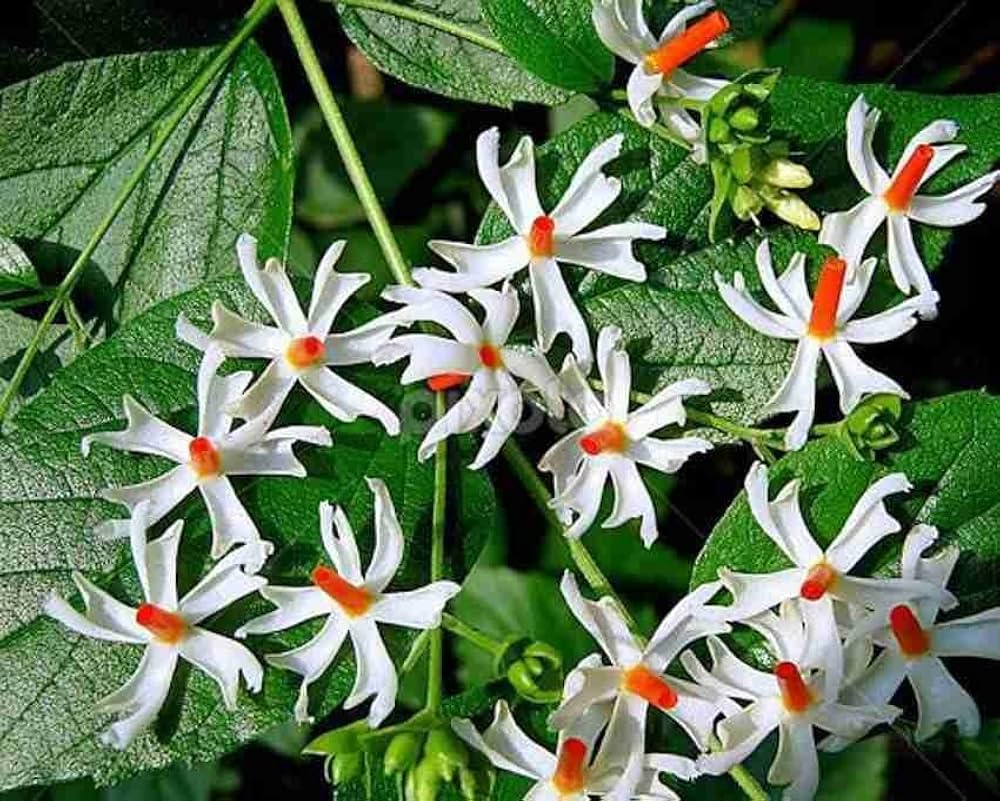
Parijat / Harsingar (Nyctanthes arbor-tristis)
The Parijat tree, also known as Harsingar or Night Jasmine, is one of India’s most beloved sacred and medicinal plants. Known for its fragrant white flowers with vivid orange centres, the tree blooms at night and sheds its flowers by morning, creating a beautiful carpet beneath its branches.
Scientifically known as Nyctanthes arbor-tristis, Parijat holds a special place in Indian mythology, Ayurveda, devotional practices, and spiritual symbolism. Its unique flowering pattern has inspired associations with impermanence, surrender, devotion, and the transformation of sorrow into peace.
- Botanical Profile: Scientific Understanding
Scientific Name: Nyctanthes arbor-tristis
Family: Oleaceae (Olive family, which also includes jasmine relatives)
Morphology
- Type: Small tree or large shrub, capable of growing up to approximately 10 metres under suitable conditions.
- Leaves: Opposite leaves with a rough texture and slightly hairy surface.
- Flowers: Small, fragrant flowers with white petals surrounding a deep orange tubular centre.
- Flowering Pattern: Flowers generally open at night and fall by morning, creating a distinctive floral carpet beneath the tree.
- Fruit: A flattened, heart-shaped capsule containing seeds.
The Unique Character of Parijat
One of the most remarkable characteristics of Parijat is its flowering cycle: its blossoms open in darkness and fall at dawn.
Symbolically, this pattern can be understood as an expression of beauty that does not cling to itself. The flower offers its fragrance freely and then lets go.
This natural cycle forms the foundation of many spiritual interpretations associated with Parijat.
- Sanskrit Names and Their Meanings
Parijat is known by several names that reflect its celestial associations, fragrant flowers, and nocturnal flowering habit.
Main Names
- पारिजात (Parijata): A name associated in Indian mythology with a celestial tree originating from divine realms.
- हरसिंगार (Harsingar / Harshringar): The common name used for this fragrant, night-blooming tree.
- शेफालिका (Shephalika / Shefali): Traditional names associated with the plant.
- रात्रिजा (Ratrija): Interpreted as “born at night.”
- निशिपुष्पा (Nishipushpa): Interpreted as “night flower.”
The Meaning of Arbor-tristis
The Latin botanical name Nyctanthes arbor-tristis is commonly interpreted as referring to a night-flowering plant and a “tree of sorrow.”
This creates a fascinating symbolic contrast:
- Name: Sorrow or sadness.
- Experience: Fragrance, beauty, and quiet surrender.
- Spiritual interpretation: Finding peace without denying the existence of sorrow.
The contrast between its name and its delicate beauty is central to the symbolic understanding of Parijat.
- Mythological and Spiritual Stories
Parijat and Samudra Manthan
According to Hindu mythology, the celestial Parijat tree is associated with Samudra Manthan, the churning of the cosmic ocean by the devas and asuras.
The event is described in Hindu Puranic traditions as the source of several divine treasures and celestial gifts.
Parijat is also associated in some traditions with the Kalpavriksha, the wish-fulfilling celestial tree.
These associations have made Parijat a symbol of divine abundance, blessings, and the connection between earthly nature and celestial realms.
Krishna, Rukmini, and Satyabhama
A popular story in Hindu tradition connects Parijat with Lord Krishna and his queens, Rukmini and Satyabhama.
According to one version of the story:
- Krishna brings the celestial Parijat tree from heaven.
- The tree is planted for Satyabhama.
- Despite this, its flowers fall into Rukmini’s courtyard.
The story is often interpreted as a reflection on devotion, grace, and the nature of love.
Its symbolic lessons include:
- True devotion: Love and grace are not always governed by outward possession.
- Non-attachment: Something beautiful can be shared without being owned.
- Divine grace: Blessings may arrive in unexpected ways.
- Humility: The deepest forms of love do not always require recognition or control.
The details and interpretations of this story vary across traditional tellings.
Sacred Use of Parijat Flowers
Parijat flowers are used in devotional practices and may be offered to deities such as Vishnu, Krishna, and Durga, depending on local customs and family traditions.
Their delicate fragrance and short-lived beauty make them especially meaningful in rituals centred on devotion, reverence, and surrender.
The act of offering a flower can itself represent the willingness to give something beautiful without expecting anything in return.
- Esoteric and Energetic Understanding
In spiritual interpretations, Parijat is often understood as a tree of transformation, surrender, and transcendence.
Rather than symbolizing the complete removal of sorrow, it represents the possibility of relating to sorrow differently.
Core Energetic Qualities
Parijat is symbolically associated with:
- Transformation of grief: Moving from pain towards acceptance and devotion.
- Heart Chakra (Anahata): Associated with love, compassion, forgiveness, and emotional openness.
- Crown Chakra (Sahasrara): Associated in yogic traditions with spiritual awareness and transcendence.
- Surrender: Releasing the need to control every outcome.
- Non-attachment: Appreciating beauty without insisting that it remain forever.
These associations belong to spiritual and esoteric frameworks rather than scientifically established effects of the plant.
The Symbolism of Night-Blooming Flowers
Parijat flowers open during darkness, when the world is quieter and less visibly active.
This can serve as a metaphor for inner awakening: meaningful changes sometimes develop during periods of silence, uncertainty, or introspection.
The flower reminds us that growth does not always require public recognition or outward activity.
The Falling Flowers: A Lesson in Letting Go
Parijat does not hold on to its flowers indefinitely. After blooming, the flowers fall naturally to the ground.
This cycle can be interpreted as a lesson in:
- Letting go of what has completed its purpose.
- Offering one’s gifts without attachment to the outcome.
- Accepting change as a natural part of life.
- Recognizing beauty in temporary experiences.
Through this symbolism, Parijat becomes an invitation to live with greater acceptance and less possessiveness.
- Ayurveda: Traditional Healing Wisdom
Parijat has a long history of use in traditional Indian medicine. Different parts of the plant, particularly the leaves, have been investigated for their potential biological activities.
Traditional uses should be distinguished from effects established through clinical studies in humans.
Ayurvedic Properties
Traditional Ayurvedic descriptions commonly associate Parijat with the following properties:
- Rasa (Taste): Tikta (bitter) and Kashaya (astringent).
- Guna (Qualities): Laghu (light) and Ruksha (dry).
- Virya (Potency): Described as Ushna (heating) in some traditional accounts.
- Dosha Associations: Traditionally used in formulations intended to address certain Vata- and Kapha-related complaints.
Descriptions can vary among Ayurvedic sources and preparations.
Major Traditional Therapeutic Uses
- Fever and Malaria
Parijat leaves have been used in traditional medicine for fever, including certain recurrent or prolonged febrile conditions.
Scientific investigations have examined extracts of Nyctanthes arbor-tristis for antimalarial and other biological activities.
However, laboratory findings and preclinical studies do not establish that Parijat can safely or effectively treat malaria or other serious infections in humans.
Malaria requires prompt medical diagnosis and evidence-based antimalarial treatment. Herbal preparations should not be used as a substitute.
- Joint Pain and Arthritis
Parijat has traditionally been used for joint discomfort, stiffness, and complaints associated with rheumatism.
Research has investigated the anti-inflammatory properties of extracts from the plant.
Traditional applications include complaints such as:
- Joint pain and stiffness.
- Rheumatic discomfort.
- Certain musculoskeletal complaints.
- Sciatica-related symptoms in traditional practice.
Although some research suggests potential anti-inflammatory activity, this does not establish that Parijat treats arthritis or sciatica in humans.
- Digestive Health
Traditional uses of Parijat include applications for certain digestive complaints.
Depending on the preparation and traditional system, reported uses include:
- Supporting digestive function.
- Addressing selected gastrointestinal complaints.
- Mild laxative applications.
Evidence for these uses varies, and the safety of ingesting leaves or other plant parts depends on preparation and dosage.
- Respiratory Health
Traditional medicinal references describe the use of Parijat in connection with certain respiratory complaints, including:
- Cough.
- Cold-related symptoms.
- Some traditional applications for breathing difficulties.
These historical uses do not establish that Parijat is an effective treatment for asthma or respiratory infections. Anyone experiencing significant breathing difficulty should seek medical attention.
- Other Investigated Biological Activities
Scientific studies have investigated extracts of Nyctanthes arbor-tristis for several biological activities, including:
- Antibacterial activity.
- Anti-inflammatory activity.
- Antimalarial activity.
- Other potential pharmacological effects.
The strength of evidence differs across studies, and many findings are based on laboratory or animal research.
Claims about antiviral effects, immune enhancement, or treatment of particular diseases require further clinical evidence before they can be considered established medical benefits.
Parts of the Parijat Tree Used Traditionally
Different parts of the plant appear in traditional medicinal and cultural practices.
- Leaves: Commonly discussed in traditional medicinal applications.
- Flowers: Appreciated for their fragrance, devotional use, and cultural significance.
- Bark: Mentioned in some traditional preparations.
- Seeds: Used in certain traditional practices.
The plant part, preparation method, concentration, and intended application can influence both safety and potential effects. Do not assume that every part of the plant is safe to consume.
- Parijat Flower Remedy: Subtle and Emotional Healing
In contemporary spiritual and complementary healing interpretations, Parijat is associated with the transformation of grief into acceptance and devotion.
Its flowers are often used symbolically to explore the relationship between beauty, loss, and impermanence.
Emotional Indications in Spiritual Interpretations
Parijat may be associated symbolically with experiences such as:
- Deep sorrow or quiet grief.
- Spiritual longing.
- A feeling of loss that is difficult to explain.
- Difficulty letting go of attachments.
- The desire to find peace during periods of transition.
These associations describe a spiritual interpretation rather than a clinically validated indication for a flower remedy.
The Symbolic Healing Action
Within this framework, Parijat represents a movement through three symbolic transformations:
- Pain into devotion: Allowing difficult experiences to deepen compassion and spiritual reflection.
- Loss into acceptance: Recognizing that change and endings are part of life.
- Attachment into surrender: Learning to appreciate what is present without demanding permanence.
Parijat and Ashoka: Two Different Symbolic Teachings
Parijat and Ashoka are both culturally significant trees associated with sorrow, but their symbolic interpretations can be distinguished.
- Ashoka: Traditionally associated with the removal or relief of sorrow.
- Parijat: Symbolically associated with accepting sorrow and transforming it into devotion.
In this interpretation, Ashoka represents relief from grief, while Parijat represents a deeper understanding of grief and impermanence.
The Heart–Crown Connection
In esoteric interpretations, Parijat is associated with a symbolic connection between the heart and crown chakras.
This connection can represent a journey from personal love towards spiritual love, and from emotional attachment towards compassion and acceptance.
There is insufficient scientific evidence that Parijat flower remedies directly release emotional trauma, alter chakra activity, or treat psychological conditions. Such practices should not replace appropriate mental health care.
- Experiential Presence: Being with the Parijat Tree
Parijat offers a distinctive sensory experience through its fragrance, delicate flowers, and night-blooming habit.
Spending time near the tree can also provide an opportunity for quiet reflection and appreciation of nature.
Emotional Layer
People may experience different emotions while spending time near a Parijat tree, including:
- Quiet peace.
- Nostalgia and tenderness.
- Gentle reflection on memories.
- An opportunity to acknowledge sadness without becoming overwhelmed by it.
These are subjective experiences rather than guaranteed effects of the tree.
Mental Layer
The calm surroundings and fragrance may encourage some people to slow down and pay attention to the present moment.
Possible experiences include:
- Silence and stillness.
- Reduced distraction.
- Reflective awareness.
- A greater appreciation of small details in nature.
Spiritual Layer
For those who connect with its traditional symbolism, Parijat may serve as a reminder of:
- Devotion without possession.
- Acceptance of change.
- The beauty of impermanent experiences.
- The value of letting go.
The Unique Experience of a Parijat Morning
One of the most beautiful experiences associated with Parijat is walking beneath the tree in the morning, when its fallen flowers cover the ground.
The scene can evoke the feeling of walking across a carpet of blessings.
As a spiritual metaphor, the fallen flowers remind us that something can remain beautiful and meaningful even after its moment of flowering has passed.
The tree’s quiet offering becomes a lesson in gratitude, impermanence, and gentle surrender.
- Traditional and Cultural Practices
Parijat has an important place in devotional customs, garden traditions, and the appreciation of fragrant flowering plants.
Collecting Fallen Flowers
In many traditions, fallen Parijat flowers are collected for worship and devotional offerings.
Where local customs permit, collecting naturally fallen flowers is a way to appreciate the plant without unnecessarily damaging its blossoms or branches.
Offering Flowers to Deities
Parijat flowers may be offered to deities during worship, depending on the traditions and customs followed by a household or temple.
Their fragrance and delicate appearance make them a meaningful offering associated with devotion and reverence.
Natural Dyes
The orange colour of Parijat flowers is associated with natural pigment compounds, including compounds commonly discussed under the name nyctanthin.
Flower extracts have been used traditionally for colouring textiles and other materials.
The colour obtained depends on the extraction method, material being dyed, and preparation conditions.
Growing Parijat at Home
Parijat can be grown as an ornamental tree or shrub in suitable climates.
Its fragrant flowers and distinctive flowering pattern make it a popular choice for gardens, courtyards, and other outdoor spaces.
Choose a location with suitable sunlight, drainage, and room for the plant to mature. Water according to the plant’s needs and local climate.
Growing Parijat can also be an opportunity to learn about native and culturally important plants.
- Symbolic Essence: A Complete Summary
The following table summarizes the botanical, cultural, medicinal, and spiritual associations of Parijat.
| Dimension | Significance |
| Botanical | Night-blooming flowers with white petals and orange centres |
| Sanskrit | Celestial associations and traditional names such as Parijata and Shefali |
| Mythology | Divine origins, Krishna, devotion, and grace |
| Ayurveda | Traditional applications for fever, joint complaints, and other conditions |
| Scientific Research | Investigated pharmacological activities, with evidence varying by application |
| Esoteric | Surrender, impermanence, and spiritual transformation |
| Emotional | Symbolic movement from grief towards acceptance and peace |
| Cultural | Devotional offerings, garden traditions, and natural dyes |
Final Reflection: The Spiritual Teaching of Parijat
Parijat is more than a beautiful flowering tree in India’s cultural imagination. It is a symbol through which people have explored devotion, the temporary nature of beauty, and the possibility of finding peace amid sorrow.
Its flowers open in darkness, release their fragrance, and fall naturally at dawn. They do not resist the completion of their brief flowering cycle.
This simple natural pattern inspires three timeless reflections:
- Bloom in darkness: Difficult periods can become opportunities for reflection and growth.
- Give your fragrance freely: Offer kindness and beauty without making recognition or reward the condition for giving.
- Fall without resistance: Accept change and recognize that meaningful experiences need not last forever to remain valuable.
Unlike Ashoka, which traditionally symbolizes the relief of sorrow, Parijat offers a different symbolic teaching: sorrow can be acknowledged, understood, and transformed through acceptance and devotion.
In the quiet beauty of its fallen flowers, Parijat reminds us that letting go does not diminish what has been beautiful. Sometimes, it is the very act of letting go that reveals its deepest meaning.
Health Disclaimer: The medicinal uses described in this article reflect traditional knowledge and research interests, not a guarantee of clinical effectiveness. Evidence for many uses remains limited. Do not self-treat malaria, persistent fever, arthritis, asthma, or other medical conditions with Parijat preparations. Consult a qualified healthcare professional before ingesting herbal products, particularly if you are pregnant, breastfeeding, have an existing medical condition, or take prescription medicines.
