
Need Help? +91 908-239-7306 / support@aumhimalaya.com
Flower Database
Amalaki · Amla
Phyllanthus emblica L. · syn. Emblica officinalis Gaertn. · Indian Gooseberry · Emblic Myrobalan
आमलकी · The sustaining mother among fruits. Born, as the stories say, from the tears of Brahma, treasured as Vishnu’s tree, and honoured in Ayurveda as the foremost rejuvenative (rasayana) and the heart of Triphala and Chyawanprash.
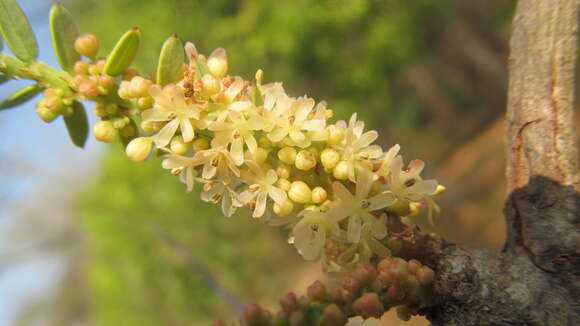
Amla (Phyllanthus emblica) flowers.
Chapter 1
Botanical Profile
Amla is a small to medium deciduous tree of the Phyllanthaceae family, typically 8–18 metres tall, with a crooked trunk, spreading branches and papery grey bark that flakes off. Its tiny, nearly stalkless leaves are arranged in neat rows along slender branchlets, so each twig looks like a feather. The genus name Phyllanthus means “leaf-flower”, as the flowers appear to grow among the leaves. It is native to tropical and southern Asia, from India and Sri Lanka to Southeast Asia and southern China.
The flowers are small, greenish-yellow or pinkish, with six segments and no true petals. Male and female flowers grow separately on the same tree, with many male flowers clustered at the base of the twigs and solitary female flowers higher up. The fruit is a nearly round, smooth, pale greenish-yellow berry with six faint furrows, which ripens in autumn and tastes sour, bitter and astringent. It is one of the richest natural sources of vitamin C and also holds tannins such as emblicanin, gallic acid, ellagic acid and flavonoids.
Illustration: feathery twig, tiny flowers and six-furrowed fruit
| Feature | Description |
|---|---|
| Family | Phyllanthaceae |
| Habit | Deciduous tree, 8–18 m; crooked trunk, spreading crown |
| Leaves | Simple, tiny, nearly stalkless, in two rows, so each twig resembles a pinnate leaf |
| Flowers | Small, greenish-yellow to pink, six tepals, separate male and female flowers on one tree |
| Fruit | Round, smooth, pale green-yellow with six furrows, ripening in autumn; hexagonal stone |
| Key compounds | Vitamin C, tannins (emblicanin A and B), gallic and ellagic acid, flavonoids |
| Habitat | Dry deciduous forest, grassy slopes and village groves; widely cultivated |
Not the same as “Cape gooseberry”. Amla (Indian gooseberry) is unrelated to the cape gooseberry (Physalis) or to the European gooseberry. Check the botanical name on products.
Chapter 2
Names in Sanskrit & Their Meaning
| Sanskrit | Transliteration | Meaning |
|---|---|---|
| आमलकी | Amalaki | The classical name, closely tied to amla, “sour”, its defining taste |
| धात्री | Dhatri | “Nurse” or “mother”: the one who sustains and nourishes |
| अमृतफल | Amritaphala | “Fruit of nectar (immortality)” |
| वयःस्था | Vayahstha | “That which sustains youth or age”, a name pointing to its rejuvenating use |
Regional names: Amla / Aonla (Hindi), Amloki (Bengali), Amla (Marathi, Gujarati), Nellikai (Tamil, Kannada), Usirikaya (Telugu), Nellikka (Malayalam), Indian Gooseberry (English).
Chapter 3
Mythology & Cultural Significance
Born of Brahma’s Tears
A Puranic tradition says that Brahma, absorbed in meditation on Vishnu, shed tears of joy, and from them the Amla became the first tree of creation. Because of this, it is considered a tree beloved of Vishnu, and in some traditions he is said to dwell in it.
Amla Navami & Amalaki Ekadashi
On Amla Navami, in the month of Kartik, families worship the tree, share a meal in its shade and give offerings that are said to be akshaya, never diminishing. Amalaki Ekadashi, in Phalguna, is another day when the tree is honoured with fasting and prayer to Vishnu.
Shankara’s Golden Amlas
The tale tells of the young Adi Shankaracharya, who begged for alms and received a single dry Amla fruit from a very poor woman. Moved, he composed the Kanakadhara Stotra to Lakshmi, and golden Amlas are said to have rained on the house.
Chyavana & the First Chyawanprash
The legend of the aged sage Chyavana says that the twin Ashvin physicians restored his youth with a rejuvenating preparation. This became the ancestor of Chyawanprash, which still has Amla at its heart.
Emperor Ashoka’s Last Gift
Buddhist tradition records that in his final days, the emperor Ashoka, who had lost his power, offered half an Amla fruit to the monastic community. It was the last gift of a great king.
Triphala
Amla, Haritaki and Bibhitaki together form Triphala, the “three fruits”, one of the most revered formulations in Ayurveda, valued as a daily tonic.
Chapter 4
Esoteric & Energetic Understanding
In spiritual interpretation, Amla is the tree of renewal and sustaining grace. These are traditional and symbolic associations, not scientific claims.
- The Mother (Dhatri): the nurse who sustains life, a symbol of care, patience and nourishment.
- Five tastes in one: classical texts say Amla holds every taste except salt, a living lesson in wholeness and balance.
- Ojas and vitality: in Ayurvedic thought, Amla builds ojas, the subtle essence of resilience and radiance.
- Manipura (solar plexus): linked, by its action on digestion, with inner fire, clarity and renewed energy.
- Akshaya (the undiminishing): offerings and good deeds under the tree are said to be inexhaustible.
- Sweetness after sourness: water tastes sweet after eating Amla, a gentle teaching that hardship can turn to sweetness.
After the sour comes the sweet.
Chapter 5
Ayurvedic Uses
The fruit is the main part used, fresh, dried or as a powder, juice, preserve or paste. Seeds, leaves, flowers, bark and roots also appear in traditional texts. Amla is regarded as the leading rasayana (rejuvenative).
Ayurvedic Profile
- Rasa: Amla (sour) with all other tastes except salty
- Guna: Laghu (light), Ruksha (dry)
- Virya: Sheeta (cooling)
- Vipaka: Madhura (sweet)
- Dosha: balances all three, especially Pitta
Traditional Uses
- Immunity and general rejuvenation (rasayana)
- Digestive fire, acidity and constipation
- Eyes (chakshushya), hair and skin
- Liver, blood and urinary health
- Blood sugar and cholesterol support
- Cough, cold and fatigue
Classical Formulations
- Chyawanprash: herbal jam
- Triphala: with Haritaki and Bibhitaki
- Amalaki Rasayana and Dhatryarishta
- Amla murabba and dried Amla candy
Science So Far
Amla is exceptionally high in vitamin C and polyphenols. Laboratory work and small clinical trials suggest benefits for cholesterol, blood sugar and digestion, though trials are generally small, so these remain promising rather than proven.
Health note. Amla as food is generally safe. Concentrated supplements may lower blood sugar and may affect blood clotting, so check with your doctor if you take diabetes or blood-thinning medicines or are preparing for surgery. Its sourness can irritate some sensitive stomachs. People prone to kidney stones should be careful with very high vitamin C intake. Many Chyawanprash brands are high in sugar. Consult a qualified practitioner before therapeutic use, especially in pregnancy and breastfeeding.
Chapter 6
Amla Flower Remedy
In flower-remedy practice, a remedy is a subtle, energetic preparation made from the flower’s imprint in water, not an herbal extract. Amla is approached as the flower of renewal, nourishment and sweetness after sourness.
Emotional States
- Feeling drained, dried-up or prematurely old
- Sour or resentful moods, a “bitter” outlook
- Neglecting self-care while nurturing others
- Fear of ageing or of losing vitality
Positive Qualities
- Renewed vitality and graceful ageing
- Self-nurturing and gratitude
- Sweetness and warmth after hardship
- A sustaining, motherly care for oneself and others
Flower remedies are a complementary, spiritual approach. There is insufficient scientific evidence that they treat emotional or physical health conditions, and they should not replace medical or psychological care.
Chapter 7
In the Company of the Amla Tree
Under an Amla, the light falls in a soft, lacy pattern through tiny leaves. People often describe the following (personal experiences, not guaranteed effects):
Emotional
A mothering, restful feeling, as if you are being quietly looked after.
Mental
Freshness and a light, uncluttered mind in the dappled shade.
Spiritual
Gratitude and a sense of abundance that does not run out.
Simple Practices
- Sit in its dappled shade for ten minutes and let your breath become slow and even.
- Taste the teaching: eat a small piece of Amla, then sip water and notice the sweetness that follows.
- Share a meal under the tree on Amla Navami, or with Amla in your meal, and offer the first portion with thanks.
- Plant one: it likes full sun and well-drained soil, and fruits after a few years.
- Gather gently in autumn, share fruit with neighbours and leave some for the birds.
Flowers are conscious, intelligent forces.
Explore Aum Himalaya’s Indian flower remedies for body, mind and emotions.
Shop Remedies Flowers Database