
Need Help? +91 908-239-7306 / support@aumhimalaya.com
Flower Database
Avaram · Tanner’s Cassia
Senna auriculata (L.) Roxb. · syn. Cassia auriculata L. · Avartaki · Aavarai · Tangedu
आवर्तकी · The golden flower of the dry lands. In Tamil Nadu it is tied above doors at Pongal, in Telangana it crowns the Bathukamma flower festival, and in Siddha and Ayurvedic homes its yellow blooms are brewed as a tea that has been drunk for generations.
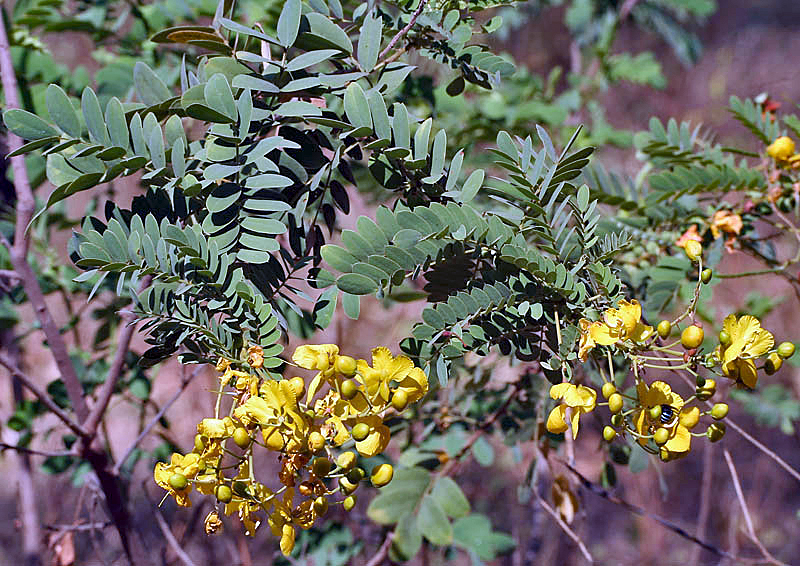
Avaram (Senna auriculata) flowers and leaves.
Chapter 1
Botanical Profile
Avaram is a hardy, much-branched shrub of the legume family (Fabaceae), usually 1–3 metres tall, with smooth reddish-brown stems. Botanists now place it in the genus Senna; the older name Cassia auriculata is still widely used. It is native to India, Sri Lanka and Myanmar, and grows wild in dry deciduous woodland and scrub up to about 600 m, tolerating poor soil, heat and drought.
The leaves are even-pinnate, 8–10 cm long, with 8 to 12 pairs of small leaflets and a pair of ear-shaped stipules at the base of each leaf, which gives the species its name auriculata, “eared”. The showy flowers are bright yellow, 4–5 cm across, with five rounded petals, in short upright clusters at the branch tips. In India, Avaram typically blooms in two bursts, in the early and late monsoon, and often blooms on and off through much of the year. The fruit is a flat brown pod 7–11 cm long with 10–20 seeds. The bark of older plants is rich in tannin (about 15–24%), and the plant was once a major source of tanning material for Indian leather, hence “Tanner’s Cassia”.
Illustration: pinnate leaf with ear-shaped stipules, yellow flowers and a flat pod
| Feature | Description |
|---|---|
| Family | Fabaceae (legumes) |
| Habit | Erect, much-branched shrub, 1–3 m; drought-hardy; reddish-brown stems |
| Leaves | Even-pinnate, 8–10 cm, 8–12 pairs of leaflets; ear-shaped stipules at the base |
| Flowers | Bright yellow, 4–5 cm, five rounded petals; short upright clusters; blooming in two main bursts in the monsoon |
| Fruit | Flat brown pod, 7–11 cm, with 10–20 seeds |
| Key constituents | Tannins, flavonoids (including quercetin), anthraquinones, polysaccharides; pyrrolizidine alkaloids reported in some parts |
| Habitat | Dry deciduous forest, scrub and wasteland, often roadsides; full sun |
Know your Cassias and Sennas. Avaram is not Cassia fistula (Amaltas, Aragvadha, the golden shower tree), not Senna alexandrina (Indian senna, a strong laxative) and not Senna occidentalis (Kasamarda), whose seeds are toxic. Check the botanical name on any product. Avaram is also a host plant for yellow butterflies such as the grass yellows and emigrants.
Chapter 2
Names & Their Meaning
| Name | Transliteration | Meaning |
|---|---|---|
| आवर्तकी | Avartaki | The classical Ayurvedic name for Avaram, and the root of the southern names Avaram and Aavarai |
| ஆவாரை | Aavarai / Aavaram (Tamil) | The Tamil and Siddha name; Aavarampoo is the flower and Ponnavarai means “golden Avarai” |
| తంగేడు | Tangedu (Telugu) | The state flower of Telangana, the flower of Bathukamma |
| तरवड | Tarvad / Tarota (Hindi, Marathi) | The common northern and western name, hinting at its tanning use |
Other names: Tangadi (Kannada), Avaram (Malayalam), Aval (Gujarati), Ranawara (Sinhala), Tanner’s Cassia, Avaram Senna and Matura Tea Tree (English).
Chapter 3
Mythology & Cultural Significance
Avaram has few Puranic tales, but it is woven deep into the festivals and healing habits of South India.
Kaappu Kattu at Pongal
On Bhogi and Pongal in Tamil Nadu, a bunch of Aavarampoo (Avaram flowers) is bound with neem leaves, mango leaves and poolai flowers and tied over doors and on roofs as a kaappu, a protective charm that welcomes prosperity and keeps away harm.
Bathukamma of Telangana
Avaram, known there as Tangedu, is the state flower of Telangana. Women stack it with other seasonal flowers to build the great domed flower arrangement of Bathukamma, the festival of the Goddess of life.
A Siddha Proverb
A well-known Tamil proverb asks whether anyone has ever seen a person die while the Avarai is in bloom nearby. It is a poetic way of saying that this plant keeps the body healthy.
The Tanner’s Plant
For centuries, villagers stripped Avaram bark to tan leather, giving the plant an important place in the rural craft economy. It is one reason the shrub was planted and protected on village lands.
A Home Remedy Plant
In Tamil households, the dried flower tea, Avarampoo bath powder and the five-part Avarai Panchanga preparation are still part of everyday healthcare traditions.
Chapter 4
Esoteric & Energetic Understanding
In spiritual interpretation, Avaram is a golden flower of protection and endurance. These are traditional and symbolic associations, not scientific claims.
- Manipura (solar plexus) chakra: its golden-yellow colour and the sun-loving, drought-hardy nature are linked with inner fire, vitality and self-confidence.
- Kaappu, the protective charm: bound above the door, it stands for the guardianship of a household at the turning of the year.
- Blooming in dryness: thriving where little else will grow, a symbol of endurance and cheerfulness in hardship.
- Women’s festivals: in Bathukamma and Pongal, it is a flower of feminine strength and community.
- Golden light: its sunny yellow flowers are used as a symbol of optimism and a bright start.
Where the land is dry, the golden flower still opens.
Chapter 5
Ayurvedic & Siddha Uses
Flowers, leaves, bark, roots and seeds are all used. In Siddha medicine, the five parts together are known as Avarai Panchanga. In Ayurveda, the flowers are described as having Pramehashamana (anti-diabetic, urinary-balancing) action.
Ayurvedic Profile
- Rasa: Kashaya (astringent), Tikta (bitter)
- Virya: Sheeta (cooling)
- Dosha: commonly described as balancing Pitta and Kapha
- Action: Pramehashamana, cooling, astringent
Traditional Uses
- Flower tea or decoction for blood sugar (prameha) in traditional diabetic care
- Excess body heat, burning urination and urinary complaints
- Skin: Avarampoo in herbal bath powders for a clear complexion
- Fever and general weakness, with the root
- Wounds and skin infections, with the bark and leaf
Science So Far
Reviews of laboratory and animal studies describe blood-sugar-lowering, antioxidant, liver-supportive and cholesterol-lowering effects, linked to flavonoids such as quercetin. Small human studies exist, but evidence remains limited.
Health note. Pyrrolizidine alkaloids, suspected of liver toxicity in high or prolonged doses, have been reported in the bark, flowers and seeds, so traditional use in moderation is wise, and heavy long-term use is not. The plant may lower blood sugar, so if you take diabetes medicines, check with your doctor, as the combination could cause hypoglycaemia. It must not replace diabetes treatment. It is traditionally avoided in pregnancy and breastfeeding. Consult a qualified Ayurvedic or Siddha practitioner before use.
Chapter 6
Avaram Flower Remedy
In flower-remedy practice, a remedy is a subtle, energetic preparation made from the flower’s imprint in water, not an herbal extract. Avaram is approached as the flower of golden resilience and protective cheer.
Emotional States
- Feeling worn down, depleted or “dried out”
- Low spirits and a lack of cheer or confidence
- Feeling exposed and in need of protection
- Difficulty finding sweetness in life’s routine
Positive Qualities
- Resilience in hard conditions
- Warm, golden optimism
- Inner confidence and vitality
- A sense of being protected and blessed
Flower remedies are a complementary, spiritual approach. There is insufficient scientific evidence that they treat emotional or physical health conditions, and they should not replace medical or psychological care.
Chapter 7
In the Company of Avaram
A hedge of Avaram in bloom is a bright, buzzing sight, with bees and yellow butterflies hovering over the flowers. People often describe the following (personal experiences, not guaranteed effects):
Emotional
Cheer and warmth, a lightness that comes from golden colour and sunshine.
Mental
Brightness and a lifting of heaviness, good company for a slow morning.
Spiritual
A sense of blessing and protection around the home and its people.
Simple Practices
- Make a Kaappu: at the turning of a season, tie a small bunch of Avaram flowers with neem and mango leaves above your door as a blessing for your household.
- Sit with the colour: watch the butterflies at the blooms for a few quiet minutes.
- Garden with it: plant it in full sun and poor, well-drained soil, with little water once established. Propagate it by seed or cuttings, and prune after flowering. It can self-seed and spread.
- Welcome pollinators: Avaram is excellent in a butterfly and bee garden.
- Respect it as medicine: if you brew the flowers, do so only under practitioner advice, and buy from trusted makers.
Flowers are conscious, intelligent forces.
Explore Aum Himalaya’s Indian flower remedies for body, mind and emotions.
Shop Remedies Flowers Database