
Need Help? +91 908-239-7306 / support@aumhimalaya.com
Flower Database
Bael · Bilva
Aegle marmelos (L.) Corrêa · Bengal Quince · Stone Apple · Golden Apple
बिल्व · Shiva’s own tree. Its three-lobed leaf is the most beloved offering to Mahadeva, its fruit is the cooling sharbat of Indian summers, and its root, leaf and fruit have long been trusted by Ayurveda for the gut and the digestion.
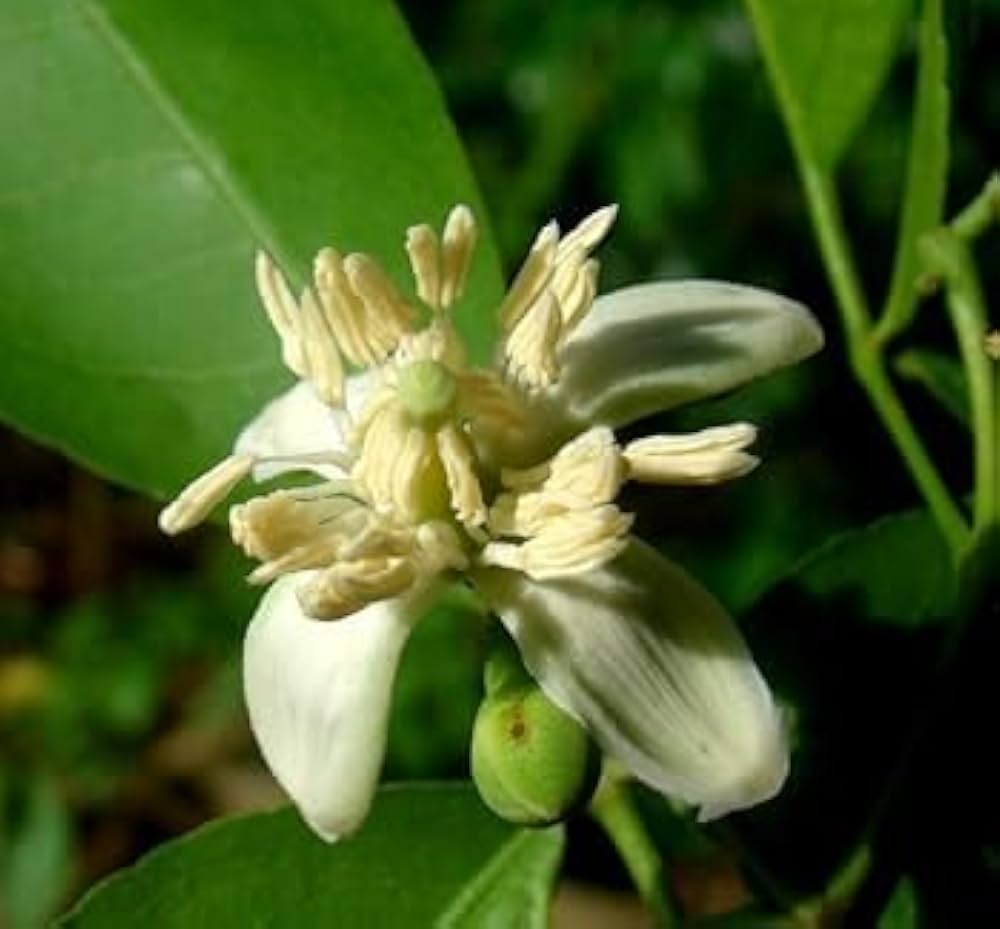
Bael (Aegle marmelos) flowers
Chapter 1
Botanical Profile
Bael is a slow-growing, deciduous tree of the citrus family (Rutaceae), usually up to 12–15 metres, with a rather open crown, slender drooping branches, soft flaking bark and sometimes stiff thorns. It is the only member of its genus, Aegle. It is native to the Indian subcontinent and Southeast Asia, growing in dry, open forests and hillsides at altitudes up to about 1,200 m, and has a reputation for thriving where other trees struggle.
The leaves are alternate and trifoliate (three leaflets, sometimes five), 4–10 cm long, and smell of citrus when crushed. In spring, usually March to May, fragrant greenish-white or pale yellow flowers about 2 cm across appear in drooping clusters of 4 to 7. Each has four recurved, fleshy petals and 50 or more stamens. The fruit is a round, hard-shelled berry 5–20 cm wide, green turning pale yellow when ripe, with sweet, sticky, orange, aromatic pulp. Key compounds include marmelosin, aegeline, tannins, coumarins and other alkaloids.
Illustration: trifoliate leaf, fragrant flowers and woody-shelled fruit
| Feature | Description |
|---|---|
| Family | Rutaceae (citrus family); the only species in the genus Aegle |
| Habit | Slow-growing deciduous tree, 12–15 m; spiny branches, flaking bark |
| Leaves | Alternate, trifoliate, aromatic; terminal leaflet long-stalked |
| Flowers | Greenish-white to pale yellow, sweet-scented; 4 recurved petals, many stamens; spring |
| Fruit | Round, 5–20 cm, woody shell, green to yellow; sticky orange pulp |
| Key compounds | Marmelosin, aegeline, tannins, coumarins, alkaloids |
| Habitat | Dry deciduous forests, hills and temple groves; India, Sri Lanka, Nepal, Southeast Asia |
Butterfly tree. Bael leaves feed the caterpillars of the Lime Butterfly and the Common Mormon, so a Bael tree is a quiet haven for swallowtails. Do not confuse Bael with kaith (Limonia acidissima), a related but different fruit that is also sometimes called “wood apple” in English.
Chapter 2
Names in Sanskrit & Their Meaning
| Sanskrit | Transliteration | Meaning |
|---|---|---|
| बिल्व | Bilva | The classical name of the tree and its fruit, the root of Hindi Bel and Bael |
| शिवद्रुम | Shivadruma | “The tree of Shiva” |
| श्रीफल | Shriphala | “Fruit of Shri (prosperity, Lakshmi)” |
| महाफल | Mahaphala | “Great fruit” |
| मालूर | Maluura | A classical synonym used in Ayurvedic texts |
Regional names: Bel / Bael (Hindi, Bengali, Marathi), Bili (Gujarati), Vilvam (Tamil), Maredu (Telugu), Bilvapatre (Kannada), Koovalam (Malayalam), Bela (Odia), Bengal Quince (English).
Chapter 3
Mythology & Cultural Significance
Shiva’s Beloved Leaf
The Bilva-patra is the offering most dear to Lord Shiva. Its three leaflets are seen as his three eyes, his trident (trishula), the three gunas and the three phases of time. The Bilvashtakam hymn praises a single trifoliate leaf offered with devotion as destroying sins of many births. It is offered especially on Mondays and on Maha Shivaratri.
The Hunter’s Night
The Shiva Purana tells of a hunter who, chased by a tiger on the night of Shivaratri, climbed a Bilva tree. Through the night, hungry and sleepless, he plucked leaves one by one and dropped them. Below was a Shiva lingam, and his unintended worship brought him liberation. It is a story that teaches that grace responds to sincerity.
Shri Sukta & Lakshmi
The Shri Sukta describes the Bilva tree as springing from the radiance of the sun-bright Goddess Lakshmi, whose own penance is said to have brought it forth. This is why the fruit is called Shriphala, and why Lakshmi is said to dwell in the tree.
Durga Puja in Bengal
At the start of Durga Puja, the Goddess is invited into a Bilva tree (Bilva Nimantran). In Bengali tradition, Rama awakened Durga out of season beneath a Bilva tree before fighting Ravana, a rite called Akal Bodhan.
Ihi: Newar Girls’ Bel Marriage
In the Newar community of Nepal, young girls are “married” to a Bel fruit in the Ihi ceremony, as a blessing that makes them symbolically wedded to the divine and lifelong protected.
A Tree to Honour
Many families plant Bael near temples, never cut a living one, and in some traditions avoid plucking leaves on certain days (such as Amavasya or Chaturthi), using fallen leaves instead.
Chapter 4
Esoteric & Energetic Understanding
In spiritual interpretation, Bael is the tree of discipline and inner stillness. These are traditional and symbolic associations, not scientific claims.
- Three in one: the trifoliate leaf stands for the unity of three, such as body, mind and spirit, the three gunas, or Brahma, Vishnu and Shiva.
- Ajna (third eye) chakra: the three-eyed symbolism of the leaf points to insight and inner vision.
- Cooling the fire: the cooling fruit is said to soothe the heat of Shiva’s ascetic fire, as well as human anger and agitation.
- Tapas (discipline): the tree’s thorns and hardy nature teach austerity and steadfastness.
- Prosperity through devotion: as the tree of Lakshmi (Shriphala), it links spiritual practice with abundance.
One leaf, offered with a whole heart, is enough.
Chapter 5
Ayurvedic Uses
Leaves, unripe and ripe fruit, root and bark are all used. The root forms part of Dashamoola, the “ten roots” formula, and Bilva is classically valued as a digestive and gut-regulating plant.
Ayurvedic Profile
- Rasa: Kashaya (astringent), Tikta (bitter)
- Guna: Laghu (light), Ruksha (dry)
- Virya: Ushna (warming)
- Dosha: unripe fruit and leaf balance Kapha and Vata
- Action: Grahi (binding), Deepana-Pachana (digestive)
Traditional Uses
- Loose stools, dysentery, IBS-type complaints (atisara, grahani), with the unripe or dried fruit
- Constipation and sluggish digestion, with the ripe fruit as a sharbat
- Fever and weakness, using the root
- Blood sugar support, with the leaf, in traditional use
- Mouth, ear and eye care in folk practice
Classical Formulations
- Dashamoola: includes Bilva root
- Bilvadi Leha and Bilvadi Gulika
- Bilva Churna from dried unripe fruit
- Bael sharbat from the ripe pulp
Science So Far
Laboratory and animal studies report anti-diarrhoeal, antioxidant, anti-inflammatory and blood-sugar-lowering effects, and small human studies are mixed. Evidence is limited, so traditional uses should be treated as traditional.
Health note. Bael as food is generally safe. Concentrated leaf, root or fruit extracts are less studied, may lower blood sugar (check with your doctor if you take diabetes medicine) and are traditionally avoided in pregnancy. The ripe fruit may be heavy to digest for some, and the unripe fruit can be constipating in large amounts. Persistent diarrhoea or blood in stool needs medical care. Consult a qualified practitioner before therapeutic use.
Chapter 6
Bael Flower Remedy
In flower-remedy practice, a remedy is a subtle, energetic preparation made from the flower’s imprint in water, not an herbal extract. Bael is approached as the flower of cooling devotion and centred stillness.
Emotional States
- Inner heat: irritation, anger, impatience
- A scattered mind, hard to focus or settle
- Spiritual restlessness or loss of discipline
- Being stuck in ego or the need to impress
Positive Qualities
- Calm, cooled, steady emotions
- Focused devotion and perseverance
- Humility and simple sincerity
- Balance of body, mind and spirit
Flower remedies are a complementary, spiritual approach. There is insufficient scientific evidence that they treat emotional or physical health conditions, and they should not replace medical or psychological care.
Chapter 7
In the Company of the Bael Tree
A Bael tree usually stands quietly near a temple or village shrine, offering cool shade and a sweet, subtle fragrance in spring. People often describe the following (personal experiences, not guaranteed effects):
Emotional
Cooling and quieting, as if heat and irritation are slowly released.
Mental
Single-pointed focus; a good place for meditation, japa or study.
Spiritual
A sense of Shiva’s presence: still, simple, powerful and compassionate.
Simple Practices
- Sit in silence under the tree, repeating Om Namah Shivaya or simply following your breath.
- One leaf offering: place a fallen trifoliate leaf, with a little water, before an image of Shiva, with full attention.
- Triple pause: breathe in, hold, breathe out, slowly, mirroring the three leaflets, for a few minutes.
- Welcome the butterflies: watch for swallowtails around the young leaves.
- Plant one in a sunny, open spot. It grows slowly, and needs patience, as devotion does. Beware of the thorns.
Flowers are conscious, intelligent forces.
Explore Aum Himalaya’s Indian flower remedies for body, mind and emotions.
Shop Remedies Flowers Database