
Need Help? +91 908-239-7306 / support@aumhimalaya.com
Flower Database
Parijat / Harsingar
Nyctanthes arbor-tristis L. · Night Jasmine · Coral Jasmine · Tree of Sorrow
पारिजात · The celestial flower that blooms in the dark and falls at dawn. A tree of Indian myth and sacred offering, whose scent fills the night and whose petals scatter softly on the ground by morning.
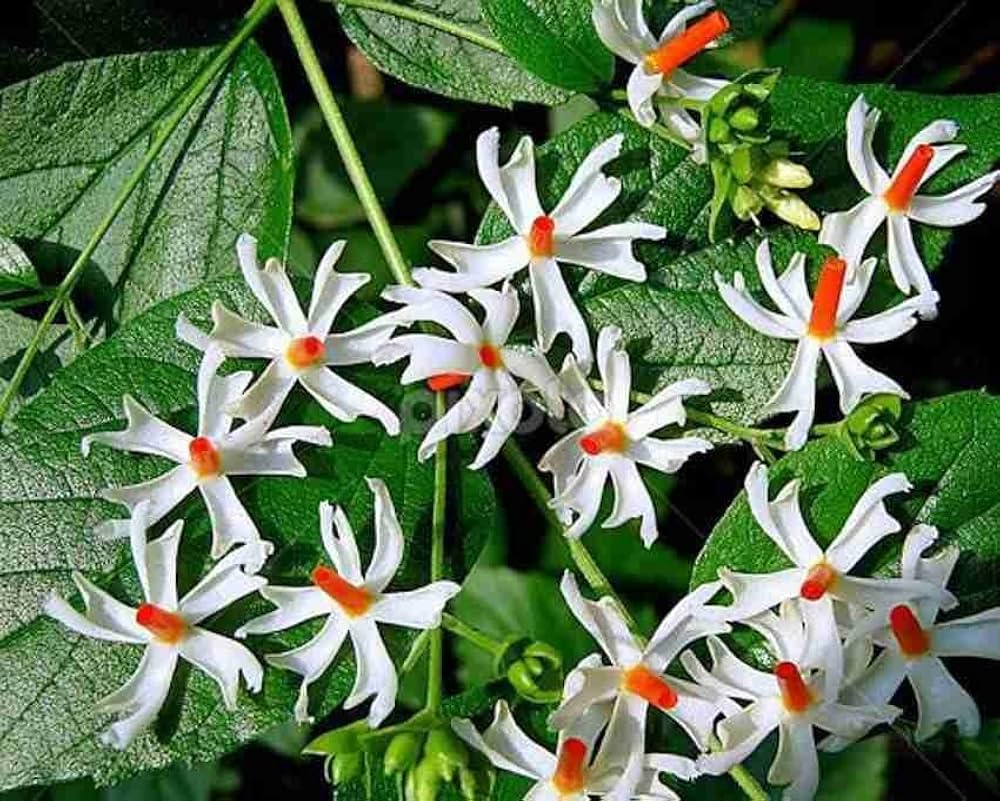
Parijat blossoms: white petals with an orange-red centre
Chapter 1
Botanical Profile
Parijat is a large shrub or small tree, up to about 10 metres, of the olive family (Oleaceae; formerly placed in Verbenaceae). It is native to the Himalayan foothills and South and Southeast Asia, and is widely planted in gardens and temple grounds. It has flaky grey bark and rough, sandpapery leaves that are opposite and simple (about 6–12 cm).
The fragrant flowers grow in small clusters of 2–7. Each has a white corolla of five to eight lobes around an orange-red tube. They open at dusk and drop before sunrise, which gave the tree its Latin epithet arbor-tristis, “sad tree”. The main flowering season is the monsoon and autumn. The fruit is a flat, rounded, two-lobed brown capsule, and the tree grows readily from seed or cuttings. It is the state flower of West Bengal, where it is called Shiuli or Shefali.
Illustration: Parijat flowers on a night branch, with fallen blossoms below
| Feature | Description |
|---|---|
| Family | Oleaceae (olive family) |
| Habit | Large shrub or small tree, up to ~10 m; flaky grey bark |
| Leaves | Opposite, simple, rough-textured, 6–12 cm long |
| Flowers | White 5–8-lobed corolla, orange-red tube; strongly fragrant at night; fall by dawn |
| Fruit | Flat, rounded, two-lobed capsule; one seed per lobe |
| Habitat | Dry deciduous forests and hillsides; Himalayan foothills to Indo-China and Indonesia |
Parijat is not a true jasmine. “Night Jasmine” and “Coral Jasmine” are popular names for its scent and the colour of its flower tube. Do not confuse it with night-blooming Cestrum nocturnum (night-blooming jasmine), a different, toxic plant.
Chapter 2
Names in Sanskrit & Their Meaning
| Sanskrit | Transliteration | Meaning |
|---|---|---|
| पारिजात | Parijata | The celestial wish-fulfilling tree of Indra’s heaven; the name is traditionally glossed as “that which blossoms all around” |
| हरश्रृङ्गार | Harshringar | Popularly understood as “ornament of Hari/Hara”, a flower fit for adorning the gods |
| शेफालिका | Shephalika | A classical name, source of Bengali Shefali |
| कल्पवृक्ष | Kalpavriksha | “Wish-fulfilling tree”; Parijata is counted among the celestial wish-granting trees |
Regional names: Harsingar (Hindi), Shiuli / Shefali (Bengali), Parijatak (Marathi), Pavalamalli (Tamil), Parijatham (Malayalam), Night Jasmine and Coral Jasmine (English).
Chapter 3
Mythology & Cultural Significance
Samudra Manthan
In the Puranic story of the churning of the cosmic ocean, Parijata is among the treasures that arose, a heavenly tree with unfading fragrance. Indra planted it in his paradise, Svarga.
Krishna & Satyabhama
In the Harivamsa and Puranas, the sage Narada gives Krishna a Parijata blossom, which he offers to Rukmini. Satyabhama, his other consort, wants the whole tree. Krishna brings it down from Indra’s heaven and plants it in her garden, but the flowers fall in Rukmini’s courtyard, a tale of love, pride and grace.
Princess Parijataka
A folk legend tells of a princess who loved the Sun and was turned away. She died of grief, and from her ashes rose a tree that cannot bear the daylight. It blooms at night and weeps its flowers at dawn, hence “tree of sorrow”.
Kintoor & the Pandavas
At Kintoor near Barabanki, Uttar Pradesh, an ancient Parijat tree is traditionally said to have been brought by Arjuna for his mother Kunti during the Pandavas’ exile.
Offering to the Divine
The flowers are traditionally offered to Vishnu, Lakshmi and Durga, and in Bengal Shiuli is a flower of Durga Puja and Mahalaya. Devotees gather only flowers that have fallen naturally, which are considered pure, rather than plucking them.
Dye & Craft
The orange-red tube of the flower yields a natural dye once used for saffron-toned cloth, including robes, and for colouring festive foods.
Chapter 4
Esoteric & Energetic Understanding
In spiritual interpretation, Parijat teaches surrender. These are traditional and symbolic associations, not scientific claims.
- Blooming in the dark: beauty and fragrance that appear in the night, a symbol of finding grace in difficult times.
- Falling at dawn: impermanence and letting go. The flower gives all it has and does not cling to the day.
- Anahata (heart) chakra: devotion, longing and tender feeling, felt through its sweet fragrance.
- Kalpavriksha: a wish-fulfilling tree, associated with sincere prayer and offering.
- Divine feminine: offered to Lakshmi and Durga, linked with devotion, abundance and Shakti.
Give your fragrance to the night, and let the morning find you light.
Chapter 5
Ayurvedic Uses
Leaves are the most commonly used part, and flowers, bark, seeds and roots are also mentioned in traditional sources. The plant appears in Ayurveda, Siddha, Unani and Homeopathy.
Ayurvedic Profile
- Rasa: Tikta (bitter), Kashaya (astringent)
- Guna: Laghu (light), Ruksha (dry)
- Virya: Ushna (warming)
- Dosha: commonly described as balancing Kapha and Vata
Traditional Uses
- Fever (jwara), the best-known use of the leaf decoction
- Joint pain, sciatica and stiffness (gridhrasi, sandhivata)
- Cough, cold and respiratory complaints
- Digestive support, worms, mild laxative action
- Seed and flower preparations for the skin and scalp in folk practice
Science So Far
Laboratory and animal studies on leaf, flower and seed extracts report anti-inflammatory, antioxidant, liver-protective and anti-microbial activity. Good human clinical trials are limited, so traditional uses should be treated as traditional.
Health note. Fever that is high or persistent, and joint pain, should be medically assessed. Traditional use does not prove safety or effectiveness. Consult a qualified practitioner before using Parijat preparations, especially during pregnancy, breastfeeding, or with other medicines. The leaves are very bitter and can upset the stomach.
Chapter 6
Parijat Flower Remedy
In flower-remedy practice, a remedy is a subtle, energetic preparation made from the flower’s imprint in water, not an herbal extract. Parijat is approached as the flower of graceful release and renewed hope.
Emotional States
- Sadness, melancholy and quiet longing
- Loneliness or unreturned affection
- Feelings held back at night: worry and restlessness
- Difficulty letting go of what has passed
Positive Qualities
- Gentle acceptance of loss and change
- Hope after dark periods
- Devotion and an open, tender heart
- Giving freely, without clinging
Flower remedies are a complementary, spiritual approach. There is insufficient scientific evidence that they treat emotional or physical health conditions, and they should not replace medical or psychological care.
Chapter 7
In the Company of the Parijat
The Parijat is best met at dusk and dawn. People often describe the following (personal experiences, not guaranteed effects):
Emotional
Softness and a settling sweetness, a feeling that it is safe to feel tender things and let them pass.
Mental
A slowing of evening thoughts; the fragrance can be a cue to breathe and unwind.
Spiritual
Devotion, gratitude and surrender; a sense of offering the day to something greater.
Simple Practices
- Dusk sit: spend a few quiet minutes near the tree as the flowers open, breathing slowly.
- Dawn gathering: collect fallen flowers in the morning, and offer them with thanks at your altar or to nature.
- Release ritual: as each flower falls, name one thing you are ready to let go of.
- Plant one near a path or window, with partial shade and well-drained soil, so its night fragrance can be enjoyed.
- Mind your senses: the scent is strong; if it gives you a headache, keep a little distance.
Flowers are conscious, intelligent forces.
Explore Aum Himalaya’s Indian flower remedies for body, mind and emotions.
Shop Remedies Flowers Database