
Need Help? +91 908-239-7306 / support@aumhimalaya.com
Flower Database
Blue Water Lily · Neel Kamal
Nymphaea nouchali Burm.f. · syn. Nymphaea stellata · Nilotpala · Blue Star Lotus · Nil Manel
नीलकमल · The sky-coloured flower of Indian poetry. The dark skin of Rama and Krishna is compared to its petals, the blue arrow of Kamadeva, the 108th offering that Rama gave to Durga, and the national flower of both Sri Lanka and Bangladesh.
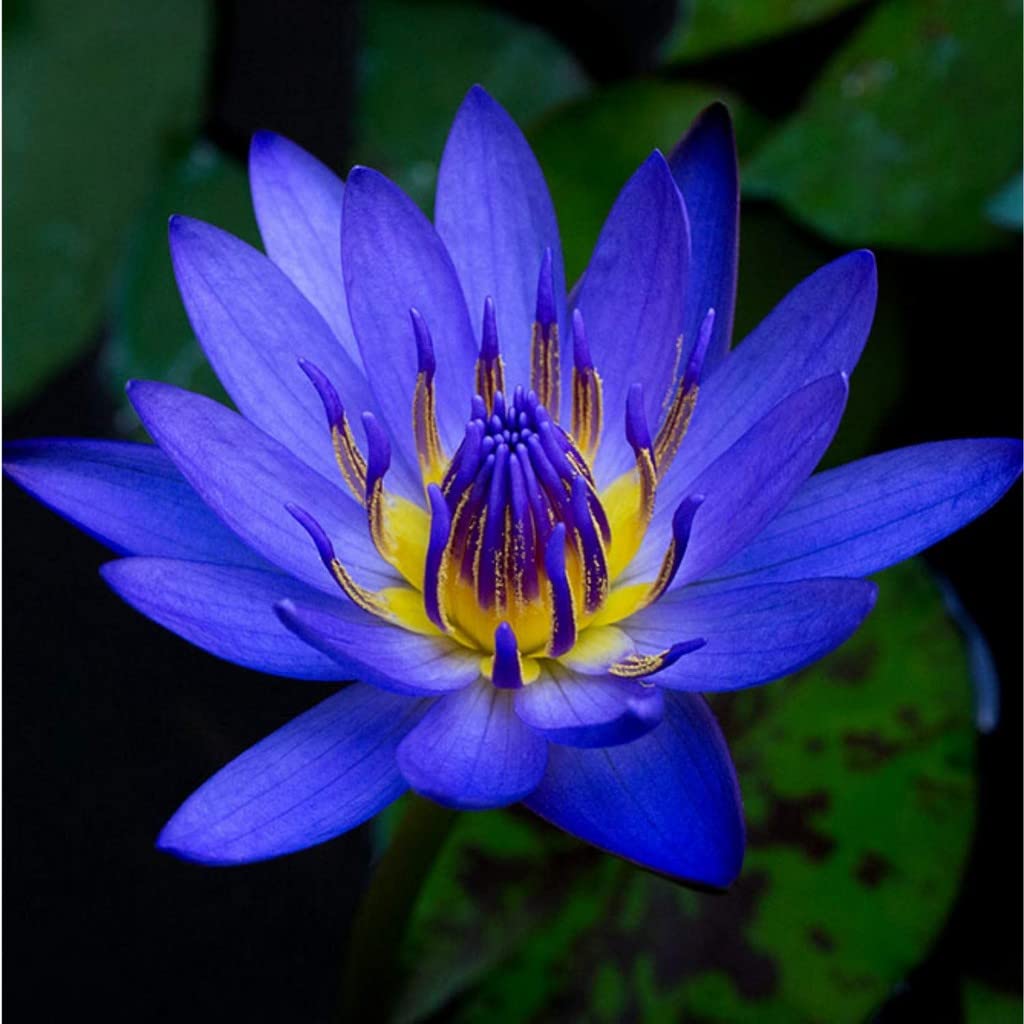
Blue water lily (Nymphaea nouchali), Neel Kamal
Chapter 1
Botanical Profile
The blue water lily is a perennial aquatic herb of the water-lily family (Nymphaeaceae). It is rooted by a tuber-like rhizome in the mud of ponds, lakes and slow streams across tropical Asia, Africa and Australia, and is widespread across the Indian subcontinent. Its leaves float on the surface: they are roughly circular, 10–25 cm wide, with a deep notch where the stalk joins and gently wavy or toothed margins. The underside is often darker, even purple-flecked.
The flowers rise on long stalks to sit just above the water. Each is about 5–15 cm across, with 4 or 5 sepals and roughly 13–15 slender, pointed petals, typically violet-blue to sky-blue with reddish or pinkish tips and a golden centre of stamens. Varieties with white, pink or mauve flowers also exist. The blooms open by day and close later, over a few days each. After flowering, the stalk bends and the spongy fruit ripens under water. Botanists sometimes treat the pale-blue Egyptian “blue lotus” (Nymphaea caerulea) as a variety of this species. It is the national flower of Sri Lanka (Nil Manel) and of Bangladesh (Shapla).
Illustration: a floating notched leaf, the blue flower and the rhizome in the mud
| Feature | Description |
|---|---|
| Family | Nymphaeaceae (water-lily family) |
| Habit | Aquatic perennial herb with a tuberous rhizome anchored in mud |
| Leaves | Floating, rounded, 10–25 cm, notched at the base, margins wavy or toothed |
| Flowers | Blue to violet (sometimes white or pink), 5–15 cm; about 13–15 pointed petals; golden stamens; held just above the water |
| Fruit | Spongy capsule maturing under water, with many small seeds |
| Key constituents | Flavonoids, anthocyanins (blue pigment), tannins, aporphine alkaloids such as nuciferine |
| Habitat | Still, shallow, sunny fresh water in ponds, lakes and paddy fields |
Not a lotus. The sacred lotus (Nelumbo nucifera, Padma) holds its round, unnotched leaves and flowers well above the water, while Neel Kamal’s notched leaves float on the surface. The name “Kamal” is used loosely for both in Hindi.
Chapter 2
Names in Sanskrit & Their Meaning
| Sanskrit | Transliteration | Meaning |
|---|---|---|
| नीलोत्पल | Nilotpala | “Blue Utpala”, the classical name for the blue water lily |
| उत्पल | Utpala | The classical term for water lilies of the Nymphaea group, often used especially for the blue kind |
| इन्दीवर | Indivara | A poetic Sanskrit word for the blue lotus or water lily, common in Kalidasa and other poets |
| कुवलय | Kuvalaya | A classical poetic name for the blue water lily |
| कुमुद | Kumuda | The related white “moon-lily” that opens at night; in some regions the name is also applied to this plant |
Regional names: Neelkamal / Neelotpal (Hindi), Neel Kamal / Poyana (Gujarati), Kumud (Marathi), Shaluk / Shapla (Bengali), Aambal (Malayalam), Neithal / Aambal (Tamil), Komale / Naidile (Kannada), Kasturi Salak (Konkani), Bhetphul (Assamese), Nil Manel (Sinhala), Blue Star Water Lily (English).
Chapter 3
Mythology & Cultural Significance
Rama’s 108 Blue Lotuses
Before the battle with Ravana, Rama, in the Bengali tradition, worshipped Durga with 108 blue lotuses (Neel Kamal), the rite known as Akal Bodhan. When Durga hid one flower to test him, Rama offered his own lotus-shaped eye in its place, and the Goddess appeared to bless him. The tale is remembered at Durga Puja, and some people call the blue water lily “Durga’s flower” for this reason.
Dark as the Blue Lily
Classical poetry describes Rama and Krishna as nilotpala-shyama, with skin the deep hue of a blue lotus, and Vishnu as lotus-eyed. In some regions the flower is called Krishna Kamal.
Arrow of Kamadeva
The blue lotus is one of the five flowery arrows of Kamadeva, god of love, together with the Ashoka blossom, white lotus, mango blossom and jasmine.
Buddhist Sacred Art
In Tibetan and Himalayan Buddhism, Green Tara and Manjushri hold a blue utpala, symbolising wisdom, compassion and the victory of the spirit over the senses.
Neithal in Sangam Poetry
In classical Tamil poetry, the neithal flower marks the seashore landscape and the mood of evening, patient waiting and longing.
National Flowers
Neel Kamal is the national flower of Sri Lanka, where it is Nil Manel, and of Bangladesh, where it is Shapla, a symbol of beauty, purity and the land of ponds and rivers.
Chapter 4
Esoteric & Energetic Understanding
In spiritual interpretation, the blue water lily is the flower of serene wisdom rising from mud. These are traditional and symbolic associations, not scientific claims.
- Rising from the mud: rooted in darkness, it opens in the sun untouched by the water, a teaching that purity and clarity can grow from hardship.
- Vishuddha (throat) chakra: its sky-blue colour is linked with truthful expression, much like Shiva’s blue throat, which transforms poison into medicine.
- Ajna (third eye): blue and indigo stand for insight, intuition and inner vision.
- Cool serenity: a flower of water, associated with calming emotions and the soothing of inner heat.
- Devotion without clinging: as Rama’s offering shows, the supreme flower is the one given with total surrender.
Rooted in mud, opening to the sky.
Chapter 5
Ayurvedic & Traditional Uses
Flowers, rhizomes, seeds and leaf stalks are used. In classical texts, Utpala (the water lily group) is a cooling plant that appears in lists such as the Utpaladi group of the Sushruta Samhita.
Ayurvedic Profile
- Rasa: Madhura (sweet), Tikta (bitter), Kashaya (astringent)
- Virya: Sheeta (cooling)
- Dosha: chiefly pacifies Pitta
- Action: Daha-hara (relieves burning), Trishna-hara (quenches thirst)
Traditional Uses
- Burning sensations, excess heat and thirst
- Cooling flower syrups and drinks in summer
- Fever and Pitta-type bleeding conditions
- Rhizome and seeds as food and as a tonic
- Calming support for restlessness and disturbed sleep in folk use
- Blood sugar support from rhizome and flower in traditional medicine
Science So Far
Laboratory and animal studies on Nymphaea nouchali extracts report antioxidant, anti-inflammatory, liver-protective and blood-sugar-lowering effects. Human studies are lacking, so the traditional uses remain traditional.
Health note. Eat water-lily rhizomes, stalks and seeds only if grown in clean water and well cooked, as wild pond plants may carry parasites. The plant contains alkaloids such as nuciferine that can be sedating and may interact with sleep medicines or lower blood pressure or blood sugar. “Blue lotus” teas, tinctures and vapes sold for relaxing or psychoactive effects are poorly regulated and are not recommended. Avoid in pregnancy and breastfeeding, and consult a qualified practitioner before therapeutic use.
Chapter 6
Blue Water Lily Flower Remedy
In flower-remedy practice, a remedy is a subtle, energetic preparation made from the flower’s imprint in water, not an herbal extract. The Blue Water Lily is approached as the flower of calm clarity and serene expression.
Emotional States
- Emotional turbulence, “muddy” feelings and overwhelm
- Feeling weighed down by the past
- Difficulty speaking one’s truth calmly
- Overstimulation, restlessness and heat of the mind
Positive Qualities
- Serenity and emotional clarity
- Purity of heart, unstained by circumstance
- Gentle, truthful expression
- Spiritual aspiration and quiet devotion
Flower remedies are a complementary, spiritual approach. There is insufficient scientific evidence that they treat emotional or physical health conditions, and they should not replace medical or psychological care.
Chapter 7
In the Company of the Blue Water Lily
A pond of blue water lilies at morning is a quiet, luminous place, with dragonflies skimming the pads and bees visiting the golden centres. People often describe the following (personal experiences, not guaranteed effects):
Emotional
Coolness and calm, as if the water itself were soothing the heart.
Mental
A settled, mirror-like mind, with fewer ripples of thought.
Spiritual
A sense of openness and devotion, of rising from difficulty without being stained by it.
Simple Practices
- Morning gaze: sit by a pond and rest your eyes softly on a bloom for five minutes, breathing slowly.
- Mud-to-bloom reflection: think of one difficulty that is now helping you grow, and thank it.
- Offer with surrender: as Rama did, offer one flower, or one sincere prayer, held with an open heart.
- Grow it: a wide container of still water in full sun (at least five or six hours), with a few fish or mosquito bits to control larvae.
- Leave wild blooms in the water, and take only cultivated flowers for worship.
Flowers are conscious, intelligent forces.
Explore Aum Himalaya’s Indian flower remedies for body, mind and emotions.
Shop Remedies Flowers Database