
Need Help? +91 908-239-7306 / support@aumhimalaya.com
Flower Database
Banyan Tree · Vata
Ficus benghalensis L. · Indian Banyan · Bengal Fig · Nyagrodha
वट · The national tree of India and the tree that never seems to die. A single banyan can become a forest of its own, sheltering villages, gods and ancestors. Its flowers bloom in secret, hidden inside the red figs that nourish birds, bats and bees.
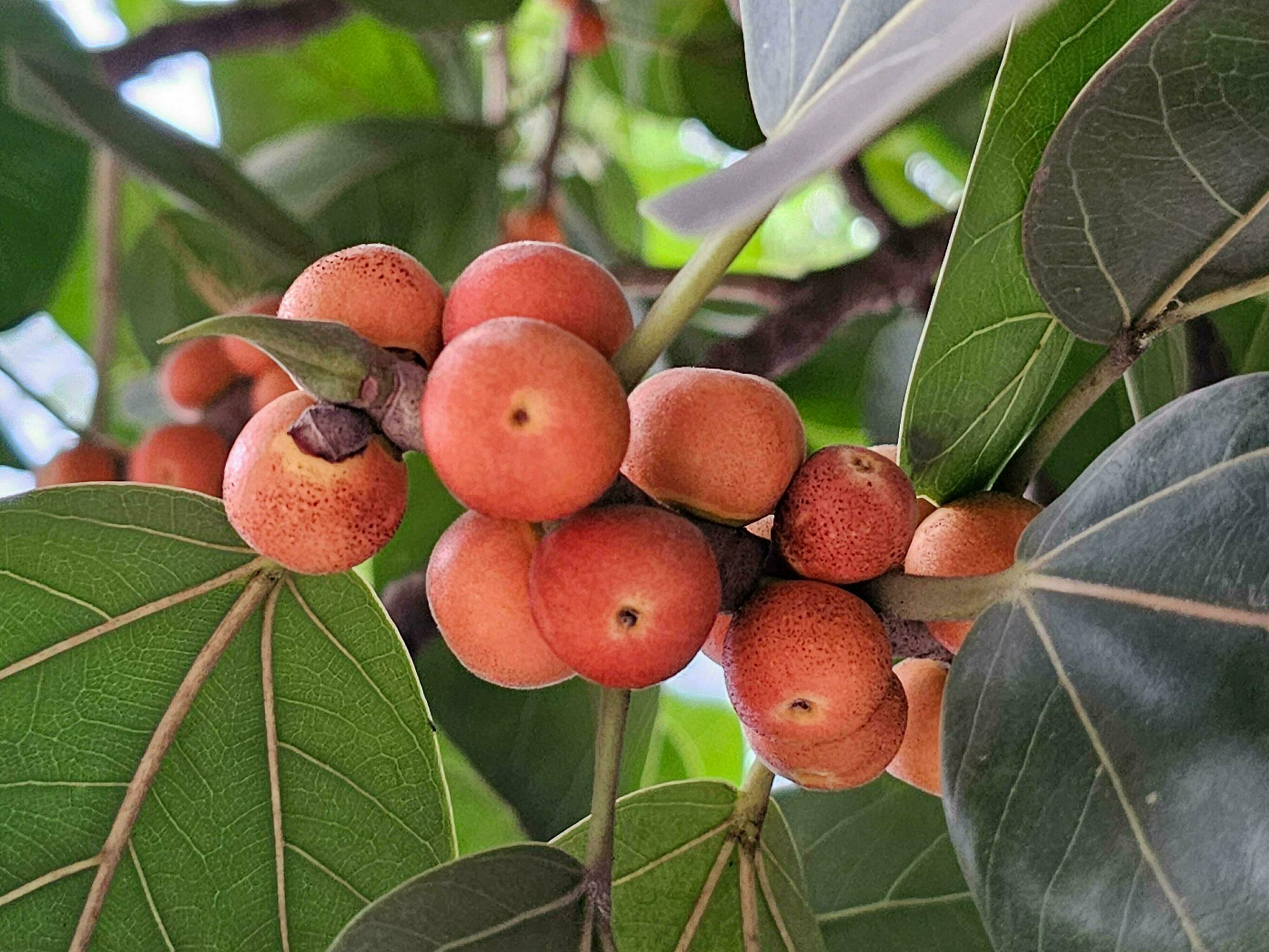
Banyan figs (Ficus benghalensis): the flowers bloom hidden inside
Chapter 1
Botanical Profile
The banyan is a giant, evergreen tree of the fig family (Moraceae), commonly 15–30 metres tall, with a vast spreading crown. It often begins life as an epiphyte, sprouting from a bird-dropped seed in a crevice or on another tree. It sends down aerial roots that thicken into pillar-like trunks, so a single tree can spread over thousands of square metres and live for centuries. All parts exude a white, milky latex. It is native to the Indian subcontinent and is the national tree of India.
The leaves are large, leathery, oval and 10–20 cm long. The banyan’s flowers cannot be seen from outside. They grow inside a small, hollow, fleshy structure, the fig or syconium, which appears in pairs at the leaf bases and ripens from green to orange to red. The inner wall is lined with hundreds of tiny male, female and gall flowers. A tiny fig wasp slips in through a small opening at the tip to pollinate them. The ripe figs, about 1.5–2.5 cm across, are eaten by birds, bats and monkeys, who spread the seeds.
Illustration: a pair of figs and a cut fig showing the tiny flowers inside
| Feature | Description |
|---|---|
| Family | Moraceae (fig family) |
| Habit | Giant evergreen tree, 15–30 m; aerial roots become pillar trunks; milky latex |
| Leaves | Alternate, leathery, broadly oval, 10–20 cm, with a rounded or heart-shaped base |
| Flowers | Tiny male, female and gall flowers hidden inside the fig (syconium) |
| Fig | Paired, globose, 1.5–2.5 cm; green turning orange then red; small opening at the tip |
| Pollinator | A specific tiny fig wasp, which breeds inside the figs |
| Key constituents | Tannins, flavonoids, sterols and triterpenes (bark); latex |
| Habitat | Plains, dry deciduous forests, roadsides, temple and village commons |
A flower you cannot see. Since a banyan’s true flowers are inside the fig, a “banyan flower” photo is really a photo of its figs. In nature, the figs feed countless creatures, which makes the banyan a keystone tree.
Chapter 2
Names in Sanskrit & Their Meaning
| Sanskrit | Transliteration | Meaning |
|---|---|---|
| वट | Vata | The classical name, often glossed as “that which encircles or shelters”; the root of Hindi Bargad |
| न्यग्रोध | Nyagrodha | “That which grows downward”, for its descending aerial roots |
| बहुपाद | Bahupada | “Many-footed”, for its multiple trunks |
| वृक्षराज | Vriksharaja | “King of trees” |
| रक्तफल | Raktaphala | “Red-fruited”, for its ripe red figs |
| यक्षावास | Yakshavasa | “Abode of Yakshas”, nature spirits said to dwell in the tree |
Regional names: Bargad / Bad (Hindi), Bot (Bengali), Vad (Marathi, Gujarati), Aalamaram (Tamil), Marri (Telugu), Aalada mara (Kannada), Peral / Aal (Malayalam), Bara (Odia), Banyan (English, from the Gujarati traders, banias, who sat in its shade).
Chapter 3
Mythology & Cultural Significance
Savitri & Satyavan
Savitri sat beneath a banyan with her husband Satyavan when Yama came for his life. Her devotion and wise words moved Yama, who gave Satyavan back. On Vat Savitri, married women circle the banyan, tie sacred threads around its trunk and pray for the long life of their husbands.
The Child on the Banyan Leaf
At the end of an age, when the world dissolves in the cosmic ocean, Vishnu is said to float as an infant on a banyan leaf (Vatapatrashayi), a sign that life will begin again. The sage Markandeya beholds this vision.
Dakshinamurthy, the Silent Teacher
Shiva sits beneath a banyan facing south as Dakshinamurthy, teaching the four young sages through silence alone. The banyan thus stands for wisdom that needs no words.
The Trinity in One Tree
Tradition holds that Brahma dwells in its roots, Vishnu in its trunk and Shiva in its branches, which is why the banyan is revered as a living temple.
Akshayavat, the Undying Banyan
The Akshayavat at Gaya is where pilgrims offer rites for their ancestors, and Sita is said to have blessed it. Another Akshayavat stands at Prayagraj. Both are honoured as imperishable.
Buddhist & Jain Traditions
The Buddha is said to have spent a week of his enlightenment period beneath the Ajapala banyan at Bodh Gaya. In Jain tradition, the banyan is linked with the first Tirthankara, Rishabhanatha.
The banyan is also the village heart: the place of the elders’ council, the market, storytelling and rest.
Chapter 4
Esoteric & Energetic Understanding
In spiritual interpretation, the banyan is the tree of rootedness and sheltering wisdom. These are traditional and symbolic associations, not scientific claims.
- Muladhara (root chakra): the great trunk and descending roots symbolise stability, belonging and ancestry.
- Many trunks, one tree: unity within diversity, a family or community growing from a single source.
- Growing downward: the name Nyagrodha reminds us that true height comes through humility and groundedness.
- The hidden flower: the banyan’s blossoms are never seen, a symbol of inner spiritual flowering that needs no display.
- Immortality: new trunks replace the old, making the tree a symbol of continuity and eternal life.
- Ancestors: the tree is a meeting place with the pitrus (forefathers), a place for remembrance and gratitude.
The deepest roots hold the widest shade.
Chapter 5
Ayurvedic Uses
Bark (twak), aerial-root tips, latex, leaves and figs are used. The banyan belongs to the Panchavalkala, the group of “five astringent barks”, valued for washes, wound care and women’s health.
Ayurvedic Profile
- Rasa: Kashaya (astringent), Madhura (sweet)
- Guna: Guru (heavy), Ruksha (dry)
- Virya: Sheeta (cooling)
- Dosha: balances Pitta and Kapha
Traditional Uses
- Bleeding conditions and heavy menstrual flow (raktapitta), traditionally with the bark
- Loose stools and dysentery
- Washes for wounds and skin conditions, as part of Panchavalkala
- Tender aerial-root tips as a tooth-cleaning stick for gum and tooth health
- Bark decoction for blood sugar support, in traditional use
- Latex applied externally for joint pain and cracked heels in folk practice
Science So Far
Studies on bark and leaf extracts mostly in animals suggest antioxidant, anti-inflammatory and blood-sugar-lowering activity. Human evidence is limited, so the traditional uses should be treated as traditional.
Health note. The white latex can irritate skin and eyes and may trigger allergy in people sensitive to latex or figs, and it should not be swallowed. Bark preparations may lower blood sugar, so check with your doctor if you take diabetes medicine. Heavy bleeding, wounds that will not heal or high blood sugar need medical care, and the banyan is not a substitute. Consult a qualified practitioner, especially in pregnancy and breastfeeding.
Chapter 6
Banyan Flower Remedy
In flower-remedy practice, a remedy is a subtle, energetic preparation made from the flower’s imprint in water, not an herbal extract. The Banyan is approached as the flower of rootedness, belonging and sheltering strength.
Emotional States
- Feeling rootless, uprooted or without a home
- Carrying a family or ancestral burden
- Insecurity and a need for stability
- Overextended in the role of protector or provider
Positive Qualities
- Deep grounding and security
- A sense of belonging and lineage
- Quiet, steady wisdom
- Generous, sheltering presence
Flower remedies are a complementary, spiritual approach. There is insufficient scientific evidence that they treat emotional or physical health conditions, and they should not replace medical or psychological care.
Chapter 7
In the Company of the Banyan Tree
Resting beneath a banyan is one of India’s oldest comforts: deep, cool shade, the calls of birds and the sense of an ancient presence. People often describe the following (personal experiences, not guaranteed effects):
Emotional
Safety and belonging, like being held by a very old, very patient elder.
Mental
A deep stillness; ideas settle and perspective widens.
Spiritual
A feeling of connection to ancestors, to lineage and to a larger, enduring life.
Simple Practices
- Silent sitting: sit with your back against a trunk or prop root, as Dakshinamurthy does, and let silence teach.
- Circle the tree slowly, as many do on Vat Savitri, offering a silent prayer for someone you love.
- Remember your ancestors: light a small lamp and name those whose roots you carry, with gratitude.
- Watch the visitors: notice the birds, squirrels and bats at the figs.
- Make space: a banyan needs a very large open area, and its roots can damage buildings and drains. For small spaces, grow it as a bonsai.
Flowers are conscious, intelligent forces.
Explore Aum Himalaya’s Indian flower remedies for body, mind and emotions.
Shop Remedies Flowers Database