
Need Help? +91 908-239-7306 / support@aumhimalaya.com
Flower Database
Arjuna Tree
Terminalia arjuna (Roxb. ex DC.) Wight & Arn. · Arjun · White Marudah · Guardian of the Heart
अर्जुन · The tall, bright-barked tree of Indian riverbanks, named for a hero and honoured as the heart’s guardian. Krishna freed two cursed souls from its twin trunks, and Ayurveda has trusted its bark for the heart for well over a thousand years.
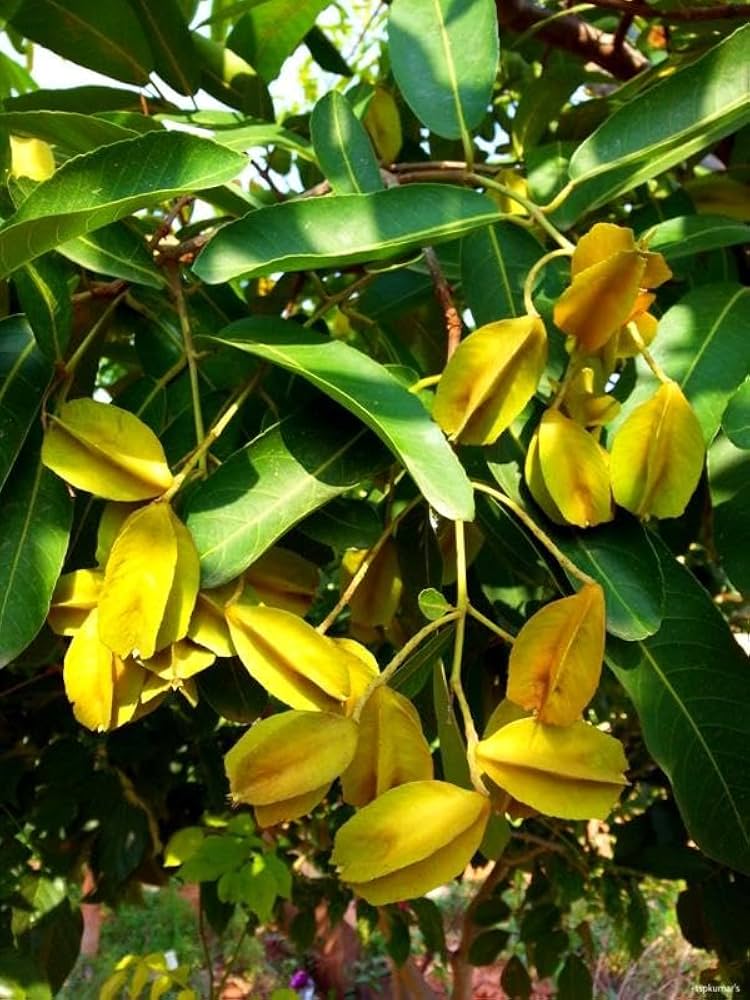
Arjuna tree (Terminalia arjuna)
Chapter 1
Botanical Profile
Arjuna is a majestic, deciduous to semi-evergreen tree of the Combretaceae (Indian almond) family. It usually reaches 20–25 metres, sometimes taller, with a buttressed trunk and a wide crown from which branches droop gracefully. The smooth, pinkish-grey bark peels in thin flakes, and the inner bark is whitish-pink and exudes a red resin when cut, which is why the tree is also called “white marudah”.
The leathery, oblong leaves are 7–20 cm long and grow in alternate or sub-opposite pairs. Small, dull pale-yellow flowers without petals appear in spikes and panicles (mainly March to June). The distinctive fruit is a hard, fibrous, woody drupe, 2.5–5 cm long, with five wings, and ripens from about September to November. Arjuna loves riverbanks, stream sides and dry riverbeds across the Indian subcontinent and is widely planted along avenues.
Illustration: leaves, flower spikes and the five-winged fruit
| Feature | Description |
|---|---|
| Family | Combretaceae |
| Habit | Large tree, 20–25 m or more; buttressed trunk, drooping branches |
| Bark | Smooth, pinkish-grey, peeling in thin plates; inner bark pale with red resin |
| Leaves | Simple, leathery, oblong, 7–20 cm; sub-opposite |
| Flowers | Pale yellow, petal-less, in spikes; spring to early summer |
| Fruit | Woody, five-winged, 2.5–5 cm; ripens in autumn |
| Key compounds | Triterpenoids (arjunic acid, arjunolic acid, arjungenin), tannins, flavonoids |
| Habitat | Riverbanks, ravines, moist deciduous forest; India, Sri Lanka, Bangladesh, Myanmar |
Ecological gift. Arjuna is a keystone tree along southern Indian rivers, with nesting places for birds and the Malabar giant squirrel. Its leaves feed the moth that gives wild tassar silk. Bark is harvested for medicine, so choose sustainably sourced products.
Chapter 2
Names in Sanskrit & Their Meaning
| Sanskrit | Transliteration | Meaning |
|---|---|---|
| अर्जुन | Arjuna | “Bright, white, clear”; the same word as the name of the Pandava hero |
| ककुभ | Kakubha | A classical name for the tree; the word also means “peak” or “summit”, for its tall, lofty stature |
| नदीसर्ज | Nadisarja | “River sarja tree”; the tree of the riverbank |
| धवल | Dhavala | “White”, for its pale bark |
| इन्द्रद्रु | Indradru | “Tree of Indra”, the king of the gods |
| वीरवृक्ष | Veeravriksha | “Hero tree” |
Regional names: Arjun (Hindi, Bengali), Sadada (Marathi), Marudha maram (Tamil), Tella maddi (Telugu), Bili matti / Holematti (Kannada), Neermaruthu (Malayalam), Arjun tree (English).
Chapter 3
Mythology & Cultural Significance
Yamalarjuna: Krishna and the Twin Trees
In the Bhagavata Purana, the young Krishna is tied to a wooden mortar by his mother Yashoda. He drags it between two great Arjuna trees and uproots them. The trees were Nalakuvara and Manigriva, sons of Kubera, cursed by the sage Narada for pride and turned into trees, and they are freed and bow to Krishna. The episode gives Krishna his name Damodara.
The Hero’s Name
The tree shares its name with Arjuna, the Pandava archer of the Mahabharata and Krishna’s friend in the Bhagavad Gita. The name means “bright”, and tradition links the hero and the tree through their luminous, steady, protective qualities. Which came first is a matter of folk etymology.
Guardian of the Heart
Vagbhata, in the Ashtanga Hridaya (about the 7th century CE), is credited with the earliest clear description of the bark in heart ailments. It is therefore known as Hridya, “good for the heart”, in classical literature.
Tree of the Rivers
Standing on the banks of sacred rivers, Arjuna is part of the landscape of pilgrimage. It is planted along roads and at temples, and its bark and leaves are used in worship and festivals in several regions.
Tussar & Craft
Its leaves nourish the moth that spins tassar silk, and its bark yields tannins used for dyeing and tanning, which tie the tree to rural craft traditions.
Chapter 4
Esoteric & Energetic Understanding
In spiritual interpretation, Arjuna is the tree of courageous love. These are traditional and symbolic associations, not scientific claims.
- Anahata (heart) chakra: the bark’s reputation as the heart’s friend makes it a natural symbol of emotional and spiritual strength in the chest.
- The warrior with a tender heart: Arjuna’s dilemma on the battlefield, torn between duty and compassion, is a model of conscious courage.
- Steadiness: the buttressed, deep-rooted trunk stands for endurance and protection through floods and storms.
- Brightness: its name and pale bark speak of clarity, truthfulness and luminous character.
- Release through grace: the Yamalarjuna story shows that what is bound can be freed by the touch of love.
The strongest heart is the one brave enough to stay open.
Chapter 5
Ayurvedic Uses
The stem bark (twak) is the principal part used; leaves, fruit and roots are mentioned in traditional sources. It is also an important plant in Siddha and Unani medicine.
Ayurvedic Profile
- Rasa: Kashaya (astringent)
- Guna: Laghu (light), Ruksha (dry)
- Virya: Sheeta (cooling)
- Dosha: balances Pitta and Kapha
- Action: Hridya (heart-supportive), Rakta-stambhaka (checks bleeding)
Traditional Uses
- Heart weakness, palpitations and chest discomfort (hridroga)
- Healthy cholesterol and blood pressure, in traditional use
- Bone and fracture healing (asthi-sandhanakara)
- Diarrhoea, bleeding, wounds and ulcers
- Asthma, urinary and skin complaints
Classical Formulations
- Arjuna Kshirapaka: bark simmered in milk and water
- Arjunarishta: fermented tonic
- Arjuna Ghrita: medicated ghee
Science So Far
Lab and animal studies, and a number of small human trials, suggest benefits for blood pressure, cholesterol and symptoms of angina or heart failure. Reviews describe the evidence as promising but limited, with larger, better trials still needed.
Health note. Heart disease is serious. Chest pain, breathlessness or palpitations need prompt medical care, and Arjuna must never replace prescribed treatment. Bark preparations may interact with medicines for blood pressure, heart conditions or blood thinning, and may cause stomach upset or constipation in some people. Arishtas contain naturally fermented alcohol. Consult a qualified practitioner, especially in pregnancy and breastfeeding.
Chapter 6
Arjuna Flower Remedy
In flower-remedy practice, a remedy is a subtle, energetic preparation made from the flower’s imprint in water, not an herbal extract. Arjuna is approached as the flower of courageous, open-hearted strength.
Emotional States
- Heartache, grief or a guarded, “armoured” heart
- Fear of vulnerability or of being hurt again
- Emotional exhaustion from carrying others
- Hesitation at a crossroads of duty and desire
Positive Qualities
- Courage with compassion
- Emotional resilience and steadiness
- An open, trusting heart
- Clear, purposeful action
Flower remedies are a complementary, spiritual approach. There is insufficient scientific evidence that they treat emotional or physical health conditions, and they should not replace medical or psychological care.
Chapter 7
In the Company of the Arjuna Tree
A mature Arjuna by a river gives wide shade, birdsong and a sense of solid presence. People often describe the following (personal experiences, not guaranteed effects):
Emotional
Steadiness and safety, a feeling of being held, and room for the heart to soften.
Mental
Clear, calm resolve; a good place to think through a difficult decision.
Spiritual
Courage, devotion and trust, with the heart as the centre of strength.
Simple Practices
- Sit with your back to the trunk and rest a hand on your heart. Breathe slowly for ten minutes.
- Ask one question: “What would my brave, kind self do?” and listen.
- Walk the riverbank and notice the birds and squirrels that live in its branches.
- Plant one where it has deep soil, sun and access to water. It grows tall, so give it space.
- Be gentle with the bark: never strip a living tree; buy responsibly sourced products.
Flowers are conscious, intelligent forces.
Explore Aum Himalaya’s Indian flower remedies for body, mind and emotions.
Shop Remedies Flowers Database