
Need Help? +91 908-239-7306 / support@aumhimalaya.com
Flower Database
Chamomile · Babuna
Matricaria chamomilla L. (M. recutita), German Chamomile · Chamaemelum nobile (L.) All., Roman Chamomile
The little sun that soothes. A daisy-like flower dedicated to the sun god in ancient Egypt, loved by Greek physicians, brewed by grandmothers across the world and known in India as Babuna through the Unani healing tradition, it is the world’s best-loved gentle herb.
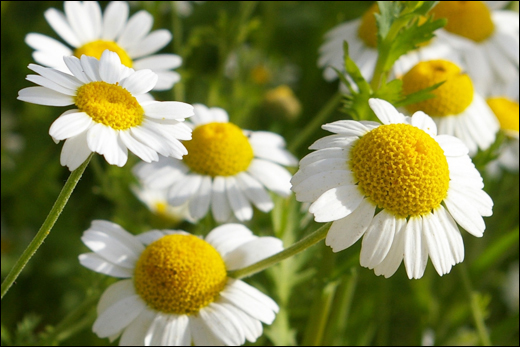
German chamomile (Matricaria recutita) flowers.
Chapter 1
Botanical Profile
“Chamomile” is the name of two related plants in the daisy family (Asteraceae). German chamomile (Matricaria chamomilla, accepted name Matricaria recutita) is an upright, branching annual, 15–60 cm tall, and is the species most used for tea. Roman chamomile (Chamaemelum nobile) is a low, creeping perennial often grown as a fragrant lawn or ground cover. Both have finely divided, feathery leaves and a sweet, apple-like scent. They are native to Europe, North Africa and western Asia and are now grown and naturalised worldwide, including in North India (for example in Punjab, Uttar Pradesh and Kashmir) for its essential oil.
The “flower” is really a head of many tiny florets: a ring of white, ray-like petals (often drooping when mature) around a raised golden-yellow cone. In German chamomile, that cone is hollow, which is a quick way to identify it. German chamomile blooms from spring into early autumn. The prized flower heads are rich in essential oil, which turns deep blue on distillation because of chamazulene, and in apigenin and other flavonoids, bisabolol and coumarins.
Illustration: a chamomile flower head and a cut cone showing the hollow centre
| Feature | German chamomile | Roman chamomile |
|---|---|---|
| Botanical name | Matricaria recutita (syn. M. chamomilla) | Chamaemelum nobile |
| Habit | Annual, upright, 15–60 cm | Perennial, creeping and mat-forming, 10–30 cm |
| Flower head | White rays around a hollow, conical yellow disc | White rays around a solid, rounded disc with small scales |
| Flowering | Late spring to early autumn | Summer |
| Key compounds | Chamazulene, α-bisabolol, apigenin, coumarins | Esters of angelic acid, flavonoids, sesquiterpene lactones |
| Typical use | Herbal tea, essential oil, skin care, the main medicinal species | Tea, aromatic lawns and gardens, perfumery |
Not a true “Indian” herb. Chamomile is a Mediterranean and European plant. It is not described in classical Ayurvedic texts. In India it is known mostly through the Unani system and, more recently, through herbal teas.
Chapter 2
Names & Their Meaning
No classical Sanskrit name. Because chamomile is not a plant of the classical Indian texts, it does not carry a traditional Sanskrit name. Its Indian name Babuna comes from the Persian and Arabic tradition.
| Name | Language | Meaning |
|---|---|---|
| Chamomile | English, from Greek chamaimēlon | “Earth apple” (chamai, on the ground, plus mēlon, apple), for the apple-like scent of the low plants |
| Matricaria | Latin | From matrix, “womb”, because it was long used for women’s complaints |
| بابونج | Arabic: Babunaj | The source of the Persian Babuneh and the Indian name below |
| बाबूना | Hindi, Urdu, Marathi: Babuna | The name used in Unani medicine and in Indian markets for chamomile flowers |
| Kamille | German | The name of German chamomile, “Echte Kamille”, meaning true chamomile |
Other names: Babuno (Gujarati), Camomille (French), Manzanilla (Spanish, “little apple”) and Scented Mayweed (English).
Chapter 3
Lore & Cultural Significance
Flower of the Sun God
In ancient Egypt, chamomile was dedicated to Ra, the sun god, because its golden disc and white rays resemble the sun. It was used for fevers and, in some accounts, in embalming and offerings.
Baldur’s Flower
In Germanic tradition, chamomile is linked with Baldur, the god of light, again for its sun-like look and gentle radiance.
The Earth Apple of the Greeks
Greek and Roman physicians, including Dioscorides, Hippocrates and Galen, wrote of chamomile as a remedy for digestion, fevers and women’s complaints, and the flower was named for its apple-like scent.
One of the Nine Sacred Herbs
An Anglo-Saxon charm of about the tenth century praises nine sacred herbs, and the one called mægðe (mayweed) is usually taken to be chamomile.
Peter Rabbit’s Tea
In Beatrix Potter’s tale, after his scare in Mr. McGregor’s garden, Peter Rabbit is put to bed with a dose of chamomile tea, a scene that helped make the herb a symbol of comfort.
Garden Folklore
Gardeners have long called chamomile the “plant’s physician” and believe it helps nearby plants thrive. It is one folk belief with limited proof, but the flowers do attract pollinators and beneficial insects.
Babuna in Unani Medicine
Unani physicians have used Babuna for centuries as a soothing, warming flower for digestion, pain and sleep. It has a place in the Unani formulary in India and is grown for essential oil in parts of the north.
Chapter 4
Esoteric & Energetic Understanding
In spiritual interpretation, chamomile is the gentle sun of the herb world. These are traditional and symbolic associations, not scientific claims.
- The little sun: white rays around a golden centre make it a natural solar symbol, a gentle warmth rather than a blazing fire.
- Manipura (solar plexus) chakra: its soothing action on the stomach has linked it with the “gut feeling” centre of nervousness and self-worth.
- Heart and nurture: a flower of the nurse and the grandmother, associated with comfort, patience and kindness.
- Sleep and dreams: its calming aroma is traditionally linked with restful sleep and peaceful dreaming.
- Humble strength: a low plant that thrives when trodden, so Roman chamomile has long been planted in lawns and paths as a symbol of resilience and patience.
Gentleness is a quiet kind of strength.
Chapter 5
Traditional & Ayurvedic View
The flower heads are the part used, fresh or dried, as tea, oil, tincture, compress, gargle, bath or cream. Because chamomile is not in the classical Ayurvedic texts, no classical rasa, virya or dosha profile exists for it, and we do not assign one. It has been used for centuries in Unani, European and other traditional systems.
Traditional Uses
- Upset stomach, gas, bloating and mild indigestion
- Nervous tension, mild anxiety and restless sleep
- Menstrual cramps and discomfort
- Mouth rinses for sore gums and mouth irritations
- Skin creams and compresses for irritated or inflamed skin
- Hair rinse to brighten fair hair
Forms
- Tea: dried flowers in hot water, covered while steeping
- Essential oil: deep blue German chamomile oil, for aromatherapy and skin products
- Extracts and creams
- Babuna: dried flowers sold in Unani and herbal shops
Science So Far
Clinical studies suggest chamomile extracts may modestly reduce symptoms of generalised anxiety, improve sleep quality, and ease digestive and menstrual discomfort. Creams may soothe mild skin inflammation. Studies are often small and vary in quality, but chamomile has among the better evidence of gentle herbs.
Health note. Chamomile can cause allergic reactions, including rarely severe ones, in people allergic to plants of the daisy family, such as ragweed, chrysanthemums, marigolds and daisies. It contains coumarin-like compounds and may add to the effect of blood thinners such as warfarin, and its calming effect may add to sedatives. It is best avoided in large amounts during pregnancy, and an eyewash made at home is not safe. Consult a doctor before using chamomile if you take medicines, and consult one for ongoing anxiety or sleep problems.
Chapter 6
Chamomile Flower Remedy
In flower-remedy practice, a remedy is a subtle, energetic preparation made from the flower’s imprint in water, not an herbal extract. Chamomile is approached as the flower of emotional calm and gentle comfort.
Emotional States
- Irritability, restlessness and a short temper
- Tension held in the stomach and solar plexus
- Trouble settling for sleep or winding down
- Emotional sensitivity and being easily upset
Positive Qualities
- Calm, even emotions
- Patience and gentleness
- A sense of being soothed and cared for
- Ease in letting the day go
Flower remedies are a complementary, spiritual approach. There is insufficient scientific evidence that they treat emotional or physical health conditions, and they should not replace medical or psychological care.
Chapter 7
In the Company of Chamomile
A patch of chamomile in bloom is a sea of tiny white suns, with a clean, sweet, apple-like scent that is strongest in warm sun and when the plants are brushed. People often describe the following (personal experiences, not guaranteed effects):
Emotional
Softness, safety and a sense of being looked after, as with a warm cup in cold hands.
Mental
Slower thoughts and an easing of tension, a pleasant companion before sleep.
Spiritual
Gratitude for small things, and a gentle, sunny trust in the day.
Simple Practices
- Evening cup: steep a spoonful of dried flowers in a covered cup for 5–10 minutes. Sip slowly, with no screen, as a small ritual of winding down.
- Brush and breathe: gently run your hand over the plants, and inhale the apple scent for a few slow breaths.
- Warm compress or bath: a few handfuls of flowers steeped in bath water make a soothing end to the day.
- Grow it: sow German chamomile in sun in spring, or plant Roman chamomile as a lawn or path edge. Both like well-drained soil, and picking the flowers encourages more.
- Welcome the pollinators: chamomile feeds bees, hoverflies and other beneficial insects.
Flowers are conscious, intelligent forces.
Explore Aum Himalaya’s Indian flower remedies for body, mind and emotions.
Shop Remedies Flowers Database