
Need Help? +91 908-239-7306 / support@aumhimalaya.com
Flower Database
Clove · Laung
Syzygium aromaticum (L.) Merr. & L.M.Perry · syn. Eugenia caryophyllata · Lavanga · Karayampoo
लवङ्ग · The flower that is harvested before it blooms. Every clove in your kitchen is a tiny unopened flower bud, once worth more than gold and the reason ships crossed oceans. For thousands of years it has warmed Indian food, sweetened the breath of the temple, and soothed the aching tooth.
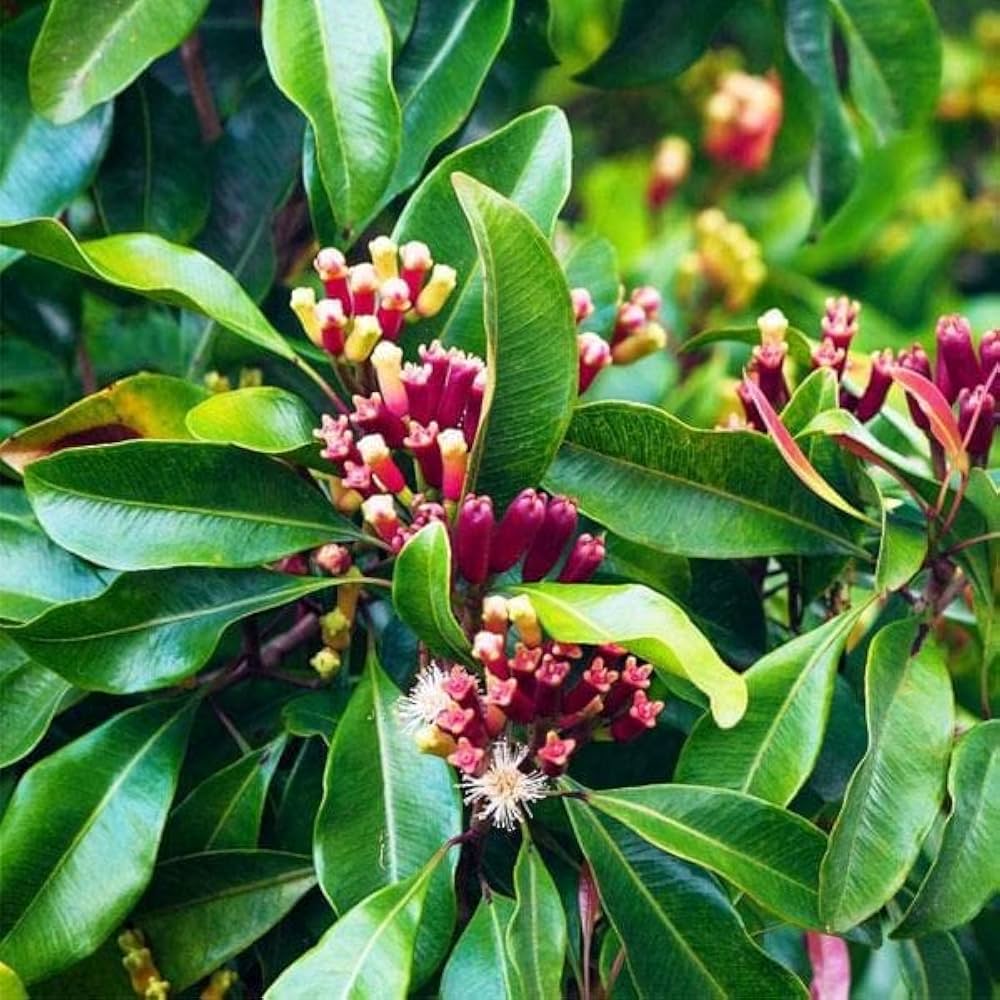
Clove (Syzygium aromaticum).
Chapter 1
Botanical Profile
Clove is a tropical evergreen tree of the myrtle family (Myrtaceae), usually 8–12 metres tall, with a neat pyramid-shaped crown, smooth grey bark and glossy, leathery, oval leaves in opposite pairs, speckled with tiny oil glands that make them aromatic when crushed. Its name Syzygium comes from the Greek for “joined”, for the paired leaves. It is native to the Maluku (Moluccas or “Spice Islands”) of Indonesia and is now grown in Zanzibar, Madagascar, Sri Lanka and, in India, mainly in Kerala, Tamil Nadu (Kanyakumari and the Nilgiris) and Karnataka.
The spice is the flower. Clove buds grow in clusters of about three at the tips of branches. They first appear pale green, then turn pink and finally a vivid crimson-red. They are hand-picked at that moment, before they open, and sun-dried until they turn dark brown. If left on the tree, the bud opens into a small, sweetly scented flower with four white-pink petals and a burst of stamens, and the flavour is lost. A tree takes about six to eight years to bear its first buds and then crops for decades. The oil, up to 15–20% of the bud by weight, is mostly eugenol (about 70–90% of the oil), with eugenyl acetate and caryophyllene. The word clove itself comes from the Latin clavus, “nail”.
Illustration: clove buds from green to red, the open flower and a dried clove
| Feature | Description |
|---|---|
| Family | Myrtaceae (myrtle family) |
| Habit | Evergreen tree, 8–12 m; pyramidal crown; aromatic throughout |
| Leaves | Opposite, glossy, leathery, elliptic, 5–13 cm; gland-dotted |
| Flower bud (the spice) | Clusters of about three at branch tips; green to pink to crimson; picked before opening and sun-dried to brown |
| Open flower | Small, scented, four white-pink petals and many stamens; short-lived |
| Fruit | Fleshy oval berry, the “mother of cloves” |
| Key constituents | Eugenol, eugenyl acetate, β-caryophyllene, tannins, flavonoids |
| Habitat | Warm, humid, well-drained tropical lowlands and hill slopes, often near the sea |
Not to be confused with “clove” in garlic. A clove of garlic is a bulb segment from a different plant. The spice clove is the dried flower bud of Syzygium aromaticum.
Chapter 2
Names in Sanskrit & Their Meaning
| Sanskrit | Transliteration | Meaning |
|---|---|---|
| लवङ्ग | Lavanga | The classical Ayurvedic name for clove; the source of Hindi Laung, Marathi Lavang and Telugu Lavangalu |
| देवकुसुम | Devakusuma | “Flower of the gods” |
| श्रीप्रसून | Shriprasuna | “Auspicious blossom” |
Regional names: Laung (Hindi), Labongo (Bengali), Lavang (Marathi, Gujarati), Kirambu (Tamil), Karayampoo (Malayalam), Lavanga (Kannada), Cengkeh (Indonesian), Clove (English, from Latin clavus, “nail”).
Chapter 3
Mythology & Cultural Significance
Clove is not the hero of a Puranic myth, but it has one of the most dramatic histories of any flower.
The Spice Islands
For centuries cloves grew on only a handful of tiny islands in Maluku, such as Ternate and Tidore. Arab, Indian and Chinese traders carried them across the sea, and by Roman times cloves had reached the Mediterranean, selling for extraordinary prices.
Courtiers’ Breath
Chinese records of the Han dynasty describe officials holding cloves in their mouths when speaking to the emperor, to sweeten the breath, one of the oldest recorded uses of the spice.
Monopoly & Smuggling
In the 1600s, the Dutch East India Company seized control of the clove trade and destroyed trees outside their reach to protect it. In the 1770s, the Frenchman Pierre Poivre smuggled out clove seedlings, breaking the monopoly and spreading the tree to Mauritius, Zanzibar and beyond.
A Tree for Every Birth
In Maluku tradition, a clove tree is planted when a child is born, and the child and the tree are believed to grow together.
Tambula and the Temple
In Indian worship and hospitality, tambula (betel leaf with areca, cardamom and clove) is offered to deities and guests. A pinned clove holds a paan or the sweet lavang latika together, and cloves are part of garam masala, chai masala and festive biryanis.
Smoke and Sanctity
In many Indian homes, a clove is added to camphor or incense in evening prayers, and folk tradition holds that it purifies the air and wards off negativity.
Chapter 4
Esoteric & Energetic Understanding
In spiritual interpretation, clove is the flower of concentrated warmth and protection. These are traditional and symbolic associations, not scientific claims.
- The unopened flower: the power of clove lies in its bud, a symbol of potential gathered and not yet spent.
- Agni and Manipura: its heat and pungency are linked with the inner fire of digestion and willpower at the solar plexus.
- Protection: its sharp fragrance is used in folk practice to cleanse a space and guard the home.
- Flower of the gods (Devakusuma): as an offering, it carries the intention of devotion, sweetness and purification.
- The nail: the name “clove” means nail, a symbol of holding things in place and keeping one’s centre.
The smallest bud can hold the strongest fire.
Chapter 5
Ayurvedic Uses
The dried flower bud (lavanga) is the main part used. The oil, leaves, stem and fruit also have traditional uses, and clove is one of the most valued household spices of Ayurveda.
Ayurvedic Profile
- Rasa: Katu (pungent), Tikta (bitter)
- Guna: Laghu (light)
- Virya: Sheeta (cooling in classical texts, although it feels warming to many)
- Vipaka: Katu
- Dosha: balances Kapha and Pitta
- Action: Deepana-Pachana (digestive), Shula-hara (pain-relieving)
Traditional Uses
- Toothache, gum problems and bad breath
- Nausea, indigestion, gas and colic
- Cough, cold, sore throat, hiccups and breathing difficulty (kasa, shwasa)
- Thirst and loss of appetite
- Headache, applied as a paste
- Eye health, according to classical lists
Classical Formulations
- Lavangadi Vati: lozenge for cough and throat
- Lavangadi Churna and Lavangadi Kwatha
- Clove is also a part of Trikatu-type digestive blends, Sitopaladi and many spice mixes
Science So Far
Eugenol, the main compound, has proven pain-relieving, antiseptic and antimicrobial properties, and it is used in dentistry. Small studies suggest clove gel can numb the skin of the mouth similar to a common topical anaesthetic, and extracts show antioxidant and antimicrobial activity. Evidence for other uses is still limited.
Health note. Cloves as a spice in food are generally safe. Clove oil is highly concentrated and can burn the gums and skin. Swallowing it, especially by children, can cause serious harm to the liver and nervous system, so always dilute it, never give it to young children, and do not place it directly on broken skin. Eugenol may slow blood clotting, so check with your doctor if you take blood thinners or are about to have surgery, and some people are allergic to it. Large medicinal amounts are traditionally avoided in pregnancy. Persistent toothache needs a dentist. Consult a qualified practitioner before therapeutic use.
Chapter 6
Clove Flower Remedy
In flower-remedy practice, a remedy is a subtle, energetic preparation made from the flower’s imprint in water, not an herbal extract. Clove is approached as the flower of warmth, protection and spirited clarity.
Emotional States
- Emotional coldness, numbness or flatness
- Feeling unprotected, exposed or easily drained
- Lack of zest, warmth or enthusiasm
- Worry that sits in the stomach and tension at the solar plexus
Positive Qualities
- Inner warmth and vitality
- Strong, healthy boundaries and protection
- Clear, spirited confidence
- Gentle courage and self-care
Flower remedies are a complementary, spiritual approach. There is insufficient scientific evidence that they treat emotional or physical health conditions, and they should not replace medical or psychological care.
Chapter 7
In the Company of the Clove
Walking through a clove grove, in the warm, humid air of Kerala or the Nilgiris, the whole place smells sweetly of spice, and the red buds glow among the dark leaves. People often describe the following (personal experiences, not guaranteed effects):
Emotional
Warmth, cheer and a sense of being comforted, like the smell of a festive kitchen.
Mental
Sharpened awareness and freshness, from the clean, bright aroma.
Spiritual
Reverence for the spice trail, and gratitude for something so small that holds so much.
Simple Practices
- Warm in your hands: hold one dried clove between your palms, breathe in its scent slowly three times and set an intention.
- Evening aroma: add one or two cloves to a simmering pot of water or to your evening tea.
- Clove pomander: press whole cloves into an orange to scent a room and cheer the season.
- Offer with tambula: a pinned clove in a paan is a traditional symbol of welcome.
- Visit a spice garden: the best way to meet the tree is in the Western Ghats of Kerala, Tamil Nadu or Karnataka.
Clove trees need constant warmth and humidity, so they are not easy to grow outside the tropics.
Flowers are conscious, intelligent forces.
Explore Aum Himalaya’s Indian flower remedies for body, mind and emotions.
Shop Remedies Flowers Database