
Need Help? +91 908-239-7306 / support@aumhimalaya.com
Flower Database
Ashoka Tree
Saraca asoca (Roxb.) Willd. · syn. Saraca indica L.
अशोक · “The one without sorrow.” A sacred, copper-leaved, flame-flowered tree of India that has comforted Sita, adorned the arrows of Kamadeva, and filled the pages of Ayurveda for over two thousand years.
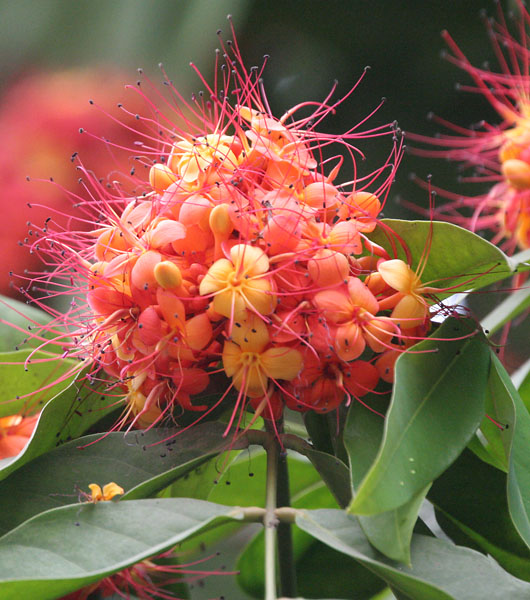
Ashoka blossoms in full flower, Kolkata
Chapter 1
Botanical Profile
The Ashoka is an evergreen, rounded-crowned tree of the legume family (Fabaceae), usually 6–10 metres tall. Its botanical name is most accurately Saraca asoca; Saraca indica is an older, widely used name for the same tree in trade and literature. It grows wild in moist, shady forests and along streams of the Western Ghats, the Eastern Ghats and sub-Himalayan foothills, extending into Sri Lanka and Southeast Asia. Wild populations are under pressure from bark harvesting, and the species is listed as Vulnerable by the IUCN.
Its flowers have no true petals: the colour comes from a showy calyx. They open bright yellow-orange and deepen to vermilion-red, in dense, fragrant clusters (February to April), strongest in the evening.
Illustration: copper young leaves, flower cluster and pod
| Feature | Description |
|---|---|
| Family | Fabaceae (legumes) |
| Leaves | Paired-pinnate, glossy, 6–12 leaflets; new leaves hang limp and are copper-red (Tamra Pallava) |
| Flowers | Petal-less, orange-yellow turning red; fragrant corymbs on trunk and branches |
| Fruit | Flat, leathery pods 10–25 cm, turning blackish-purple, with several large seeds |
| Bark | Dark brown, source of tannins, catechins and flavonoids studied in traditional medicine |
| Habitat | Moist evergreen forests, stream banks, partly shaded; India, Sri Lanka, Myanmar, Malaysia |
True vs. False Ashoka. The tall, slender roadside tree commonly called “Ashoka” (Polyalthia longifolia) is a different species and is not the medicinal Ashoka. Traditional medicinal uses of the true Ashoka should not be applied to it.
Chapter 2
Names in Sanskrit & Their Meaning
| Sanskrit | Transliteration | Meaning |
|---|---|---|
| अशोक | Ashoka | “Without sorrow” (a + shoka) — that which removes grief |
| विशोक | Vishoka | Free from sorrow; grief-dispelling |
| हेमपुष्प | Hemapushpa | “Golden-flowered” |
| ताम्रपल्लव | Tamra Pallava | “Copper-coloured tender leaves” |
| रक्तपल्लव | Raktapallava | “Red-sprouted”; the flush of new leaves |
| कंकेलि | Kankeli | A classical name for the tree, found in Ayurvedic texts |
| अङ्गनाप्रिय | Anganapriya | “Beloved of women” |
Regional names: Ashok (Hindi, Marathi, Bengali), Asogam (Tamil), Ashokam (Malayalam), Ashoka (Kannada).
Chapter 3
Mythology & Cultural Significance
Ashoka Vatika · Sita
In the Ramayana, Sita was held by Ravana in the Ashoka Vatika, a garden in Lanka. Beneath its Ashoka trees she kept her faith and dignity through captivity, and there Hanuman found her and gave her Rama’s ring. The tree became a symbol of endurance and hope in the midst of sorrow.
Kamadeva’s Arrows
Classical Sanskrit poetry counts the Ashoka blossom among the five flowery arrows of Kamadeva, god of love, alongside lotus, mango blossom, jasmine and blue lotus. Kalidasa and other poets also tell of the tree bursting into bloom at the touch of a beautiful woman’s foot, an ancient motif called dohada.
Buddhist & Jain Traditions
Some accounts link the Buddha’s birth to a flowering tree grasped by Queen Maya at Lumbini; traditions differ on which tree. In Jain art, the Ashoka tree appears above the Tirthankaras as one of the eight auspicious attendant signs.
Yakshi & Sacred Art
Sculptures at Sanchi, Bharhut and Mathura show Yakshis, nature goddesses, holding flowering branches, often Ashoka, a sign of fertility, abundance and the renewing power of the feminine.
Ashokashtami & Festivals
On Chaitra Shukla Ashtami (Ashokashtami), the tree is honoured, especially by women, and in some communities the buds are ritually taken in water. Ashoka leaves are strung as auspicious doorway garlands (toran) at weddings and festivals.
Seetha Eliya, Sri Lanka
In Sri Lanka, the Seetha Eliya site near Nuwara Eliya is traditionally identified as the Ashoka Vatika, with a temple to Sita beside the stream.
Chapter 4
Esoteric & Energetic Understanding
In spiritual interpretation the Ashoka is more than a plant: it is a teacher of emotional transformation. These are traditional and symbolic associations, not scientific claims.
- Release of Shoka: the symbol of grief giving way to hope, a tree under which sorrow is allowed to soften.
- Anahata (heart) chakra: compassion, love, emotional openness; its flame-coloured blossoms are read as the heart’s warmth reawakening.
- Shakti & the feminine: vitality, creative power and the womb as seat of creation; the “heart–womb axis” in contemporary holistic language.
- Colour as teaching: copper new leaves, golden-to-vermilion flowers; renewal passing through fire to maturity.
Where sorrow ends, the tree begins to bloom.
Chapter 5
Ayurvedic Uses
Bark (twak) is the principal part used; flowers and seeds are also mentioned in classical texts. The tree is traditionally prized as a women’s tonic.
Ayurvedic Profile
- Rasa: Kashaya (astringent), Tikta (bitter)
- Guna: Laghu (light), Ruksha (dry)
- Virya: Sheeta (cooling)
- Dosha: balances Pitta and Kapha
Traditional Uses
- Menstrual irregularities and heavy menstrual bleeding (Rakta Stambhaka, an action that checks bleeding)
- Uterine health and leucorrhoea
- Pitta complaints: burning sensation, certain skin conditions
- Digestive concerns, worms and wound care in traditional references
Classical Formulations
- Ashokarishta: fermented tonic, the best-known
- Ashoka Ghrita: medicated ghee
- Ashoka Kashaya: bark decoction
Health note. Traditional use does not prove safety or effectiveness for a given condition. Heavy or irregular bleeding has many possible causes and needs medical evaluation. Arishtas contain naturally fermented alcohol. Consult a qualified practitioner before use, especially during pregnancy, breastfeeding or with other medicines.
Chapter 6
Ashoka Flower Remedy
In flower-remedy practice, a remedy is a subtle, energetic preparation made from the flower’s imprint in water, not an herbal extract. Ashoka is approached as the flower of letting sorrow go.
Emotional States
- Deep grief and old sadness
- Suppressed or unspoken sorrow
- Emotional heaviness
- Difficulty accepting oneself
Positive Qualities
- Release of emotional burdens
- Acceptance and inner peace
- Renewed joy and an open heart
- Healthy connection with feminine identity
Flower remedies are a complementary, spiritual approach. There is insufficient scientific evidence that they treat emotional or reproductive health conditions, and they should not replace medical or psychological care.
Chapter 7
In the Company of the Ashoka
Time under any tree in a quiet green place tends to lower stress; the Ashoka adds beauty, shade and rich symbolism. People often describe the following (personal experiences, not guaranteed effects):
Emotional
A sense of lightness, quiet and relief from daily pressure; a safe place to feel grief without being swallowed by it.
Mental
A pause from distraction; mental clarity with slow, mindful breathing under the canopy.
Spiritual
An opening of the heart, compassion, gentle growth and a feeling of feminine, creative warmth.
Simple Practices
- Sit in silence for 10–20 minutes near the tree, breathing softly with attention at the heart.
- Offer water to the roots as an act of gratitude and care.
- Silently name a sorrow, then let it go with the out-breath; end with a thought of hope.
- Plant one where climate, partial shade and moist soil allow.
- Learn its stories, from Sita to the Yakshis, and share them.
Flowers are conscious, intelligent forces.
Explore Aum Himalaya’s Indian flower remedies for body, mind and emotions.
Shop Remedies Flowers Database