Need Help? +91 908-239-7306 / support@aumhimalaya.com
Flower Database
Coconut Tree · Narikela
Cocos nucifera L. · Kalpavriksha · Nariyal · Thenga
नारिकेल · The wish-fulfilling tree. Every temple ritual begins with its fruit, every coastal home leans on its shade, and its golden flowers, held in a wooden sheath for a year, give a sweet sap that India calls neera.
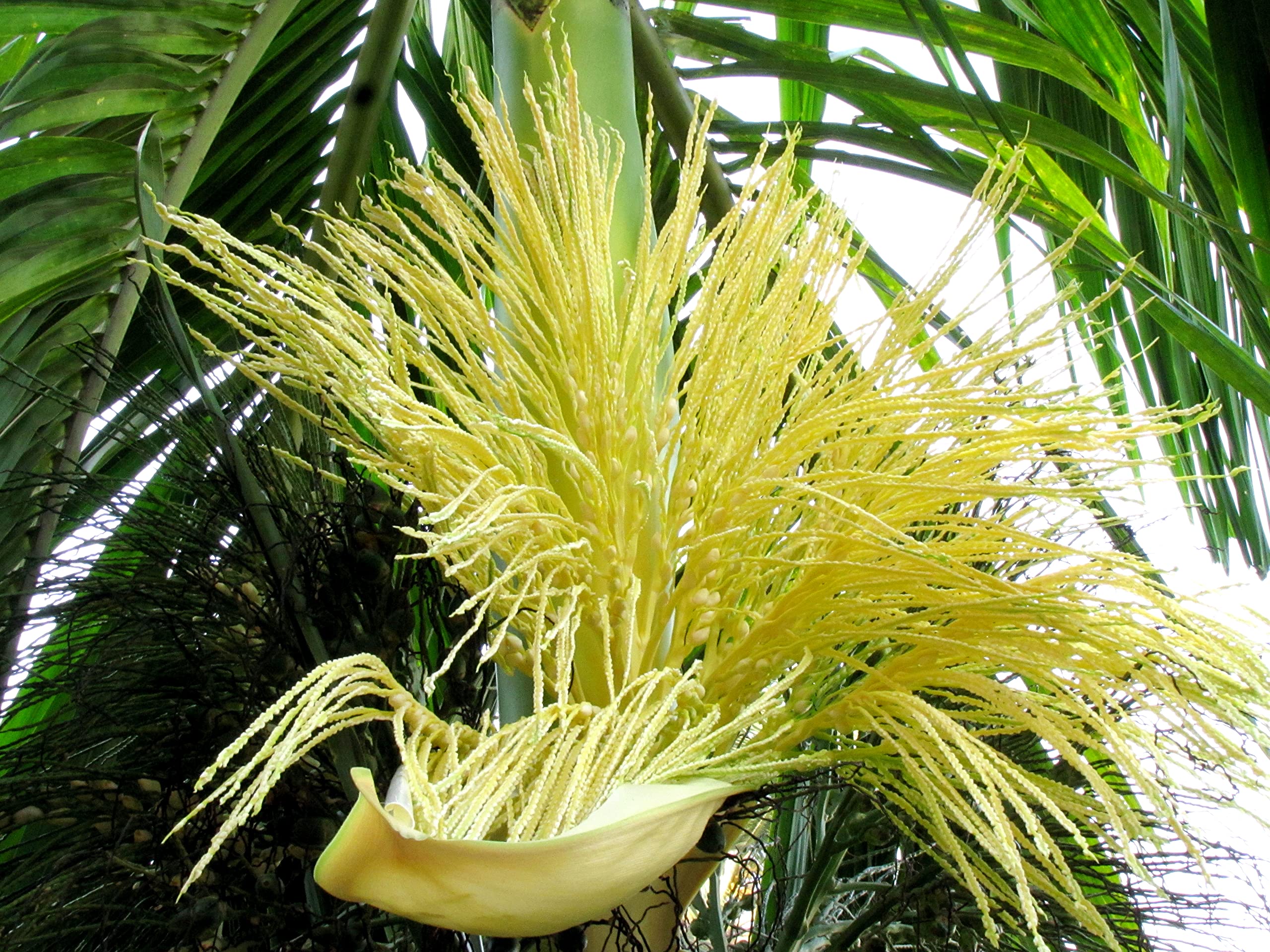
Coconut palm (Cocos nucifera) flowers
Chapter 1
Botanical Profile
The coconut is a tall, single-stemmed palm of the palm family (Arecaceae), the only living species in its genus. It grows 10–30 metres tall, often leaning, with a swollen base ringed by a mass of roots, and a crown of huge feather-like fronds 4–5 metres long, each carrying 200 or more narrow leaflets. It thrives on warm tropical coasts, in sandy soil, in salt air and in sunlight, and has been carried by sea and by people across the tropics. The name Cocos comes from the Portuguese for a monkey’s grinning face, for the three “eyes” of the nut, and nucifera means “nut-bearing”.
A new flower stalk, a spadix, develops in the angle of every leaf, and takes about a year to form. It is enclosed in a hard, woody, boat-shaped spathe, 70–100 cm long, which splits lengthwise to reveal a branching golden-cream cluster, often 1–1.5 metres long, of 20–60 spikelets. Each spikelet carries several hundred tiny male flowers (six yellow tepals and six stamens) and, at its base, one to three much larger, round female flowers that look like miniature coconuts. A single palm bears both kinds, and the male flowers open first, giving the female flowers time to be pollinated by pollen from another spadix, helped by bees, other insects and wind. Only a fraction of the female flowers, roughly a quarter to two-fifths, set into nuts, which take about a year to ripen.
Illustration: the opened spadix with its male and female flowers, and a young coconut
| Feature | Description |
|---|---|
| Family | Arecaceae (palm family); the only species of the genus Cocos |
| Habit | Single-stemmed palm, 10–30 m; leaning trunk with swollen, rooted base |
| Leaves | Pinnate fronds 4–5 m long, 200 or more leaflets |
| Inflorescence | Spadix in a woody spathe (70–100 cm), splitting to reveal 20–60 flower-bearing spikelets |
| Flowers | Male: yellow, hundreds per spikelet, open first. Female: large, round, 1–3 at the base of each spikelet |
| Fruit | A fibrous drupe, the coconut, ripening in about 12 months |
| Flower sap | Sweet sap (neera) tapped from the unopened spadix |
| Habitat | Warm, humid coasts and islands; sandy, well-drained soil; frost-free |
The flower is a source of neera. Skilled tappers cut the unopened spadix and collect its sweet sap in clean containers. Fresh, chilled neera (also called kalparasa in Kerala) is a nutritious drink and the raw material for coconut jaggery and sugar. Left in the sun, it ferments within hours into toddy, which is alcoholic.
Chapter 2
Names in Sanskrit & Their Meaning
| Sanskrit | Transliteration | Meaning |
|---|---|---|
| नारिकेल | Narikela | The classical Sanskrit name for the coconut palm and its fruit; the source of Hindi Nariyal and Bengali Narkel |
| कल्पवृक्ष | Kalpavriksha | “Wish-fulfilling tree”, the title given to the coconut palm for its many gifts |
| श्रीफल | Shriphala | “Fruit of Shri (prosperity)”, the coconut as an offering |
Regional names: Nariyal (Hindi), Narkel (Bengali), Naral (Marathi), Naliyer (Gujarati), Thengai (Tamil), Thenga (Malayalam), Kobbari (Telugu), Tengina kayi (Kannada), Pol (Sinhala), Kelapa (Indonesian, Malay), Coconut (English).
Chapter 3
Mythology & Cultural Significance
The Wish-Fulfilling Tree
The coconut palm is called Kalpavriksha, the heavenly tree that grants wishes, because every part of it serves human life: food, water, oil, fibre, shelter, fuel and sweet sap. Kerala, the “land of coconuts”, is often said to take its name from it.
Vishwamitra’s Tree
A folk legend says that the sage Vishwamitra created the coconut palm for King Trishanku, who was refused entry to heaven. The nut, with its three “eyes”, was shaped like a human head, and the tree was a second ladder to the heavens.
Breaking the Coconut
In Hindu ritual, a coconut is broken before any new beginning, such as a house, vehicle, business or journey. The hard shell stands for the ego, which must be broken, and the white kernel and sweet water for the pure heart within. Its three “eyes” are associated with Shiva’s three eyes.
The Kalasha
A coconut resting on mango leaves above a water pot forms the purna kumbha, the sacred vessel of abundance used in temples, weddings and house-warmings.
Sea and Pilgrimage
On Narali Purnima in Maharashtra, fishing communities offer coconuts to the sea god Varuna. Pilgrims to Sabarimala carry a coconut filled with ghee on their Irumudi bundle.
Flower in Ceremony
In Kerala, Sri Lanka and other coastal regions, the spathe with its golden flowers is used as an auspicious decoration at ceremonies, and the sap from the flower stalk is a traditional drink.
Tree of Life
Across the Pacific and Southeast Asia, the coconut palm is known as the “tree of life”, carried by voyagers on their canoes to plant on new islands.
Chapter 4
Esoteric & Energetic Understanding
In spiritual interpretation, the coconut is the tree of surrender and generosity. These are traditional and symbolic associations, not scientific claims.
- The hard shell and the sweet heart: breaking the coconut stands for breaking the ego to reveal the pure, sweet self within.
- Three eyes: the three markings are linked with Shiva’s three eyes and with inner vision.
- A year in the sheath: the flower stalk waits patiently within its woody spathe before it opens, a symbol of patience and timing.
- Male first, then female: the male flowers open first and the female flowers follow, a natural lesson in sequence and cooperation.
- Muladhara and Anahata: its deep roots and its sweet water are linked with grounding and with the heart’s sweetness.
- Giving everything: from root to crown, the palm gives all it has, and is a model of generosity.
Break the shell, and sweetness flows.
Chapter 5
Ayurvedic & Traditional Uses
The nut, tender coconut water, oil, flower, sap, root and shell have all been used in Ayurveda and in Siddha and folk medicine.
Ayurvedic Profile (nut and tender water)
- Rasa: Madhura (sweet)
- Guna: Guru and Snigdha (heavy, unctuous) for the kernel; Laghu (lighter) for tender water
- Virya: Sheeta (cooling)
- Dosha: balances Vata and Pitta; may increase Kapha in excess
Traditional Uses
- Tender coconut water for thirst, heat, urinary burning and replenishing fluids
- Fresh neera as a cooling, energising drink
- Flower decoctions in folk medicine for loose stools and bleeding complaints
- Coconut oil for hair, skin, massage and cooking
- Shell charcoal and roots in some traditional preparations
Science So Far
Tender coconut water is a natural source of potassium and electrolytes, and is used for mild rehydration. Fresh neera contains sugars, minerals and vitamins, and coconut sugar made from it has been reported to have a low glycaemic index in some small studies. Research on the flower itself is limited.
Health note. Neera must be collected and kept cold and clean, because it starts to ferment within hours, and fermented toddy is alcoholic. Coconut sugar is still sugar and should be limited by people with diabetes. Coconut water is high in potassium, so people with kidney disease should check with their doctor. Coconut oil is high in saturated fat. Coconut allergy is uncommon but possible. Consult a qualified practitioner before using any flower preparation medicinally.
Chapter 6
Coconut Flower Remedy
In flower-remedy practice, a remedy is a subtle, energetic preparation made from the flower’s imprint in water, not an herbal extract. The Coconut flower is approached as the flower of inner sweetness and generous abundance.
Emotional States
- A hard outer shell, difficulty trusting or softening
- Feelings of scarcity and fear of not having enough
- Emotional heat, tension and being overheated by stress
- Rigidity and a hard time letting go of control
Positive Qualities
- Sweetness and openness within
- Generosity and a sense of abundance
- Calm, cooling emotional balance
- Flexible strength, like a palm bending in the wind
Flower remedies are a complementary, spiritual approach. There is insufficient scientific evidence that they treat emotional or physical health conditions, and they should not replace medical or psychological care.
Chapter 7
In the Company of the Coconut Palm
A grove of coconut palms by the sea, with fronds clattering in the breeze, is one of the most relaxing landscapes of the tropics. People often describe the following (personal experiences, not guaranteed effects):
Emotional
Ease and holiday lightness, the sense of the sea air washing away tension.
Mental
Spacious calm, where the sound of the swaying fronds quiets the mind.
Spiritual
Gratitude for abundance, and a feeling of being provided for.
Simple Practices
- Slow sip: drink fresh tender coconut water slowly, tasting its natural sweetness and giving thanks.
- Break the shell: before a new beginning, break a coconut with an intention, offer the water and share the kernel.
- Walk the grove at dusk: listen to the fronds and breathe the sea air.
- Mind the nuts: never rest or park directly under a mature palm, as falling coconuts can cause serious injury.
- Grow one: it needs warmth (above about 20°C), sun, a sandy, well-drained soil and humidity. Dwarf kinds flower in about three to four years, and tall kinds take longer.
Flowers are conscious, intelligent forces.
Explore Aum Himalaya’s Indian flower remedies for body, mind and emotions.
Shop Remedies Flowers Database