
Need Help? +91 908-239-7306 / support@aumhimalaya.com
Flower Database
Banana Flower · Kadali Pushpa
Musa × paradisiaca L. (Musa acuminata × M. balbisiana) · Banana Blossom · Banana Heart · Vazhaipoo · Kele ka Phool
कदली पुष्प · A deep-purple heart that opens one petal-like bract at a time. The banana plant is Brihaspati’s tree, the bride of Durga Puja, the green gate of every wedding, and its flower is a humble kitchen medicine honoured across India.
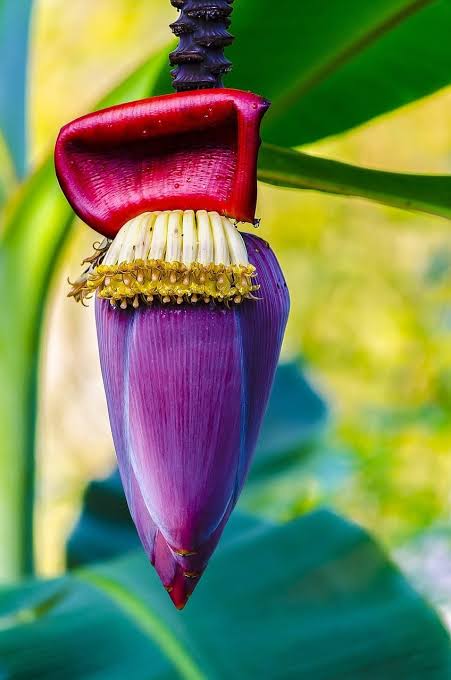
Banana flower (Kadali Pushpa)
Chapter 1
Botanical Profile
The banana is not a tree but a giant perennial herb of the family Musaceae. Its “trunk” is a pseudostem, 2–8 metres tall, made of tightly rolled leaf sheaths, and it carries huge paddle-shaped leaves up to 2–3 metres long. Most cultivated bananas are hybrids of two wild species, Musa acuminata and Musa balbisiana, and are written Musa × paradisiaca. They are native to tropical Asia and spread by suckers from an underground corm.
After nine to twelve leaves, a single flower stalk grows up through the centre of the pseudostem and emerges as a large, teardrop-shaped, purple-maroon bud, often called the “banana heart”. It bends downward, and its overlapping bracts lift one by one to reveal a double row of small cream-yellow flowers. The first rows are female (they swell into the “hands” of bananas), and the tip carries male flowers. The flowers are rich in fibre, and the bud is cooked as a vegetable after the clusters of fruit have set. After fruiting, the pseudostem dies and the suckers carry on.
Illustration: the purple bud, a lifting bract with its row of flowers, and young fruit
| Feature | Description |
|---|---|
| Family | Musaceae |
| Habit | Giant herb with a pseudostem of leaf sheaths, 2–8 m; dies after fruiting, renewed by suckers |
| Leaves | Very large, paddle-shaped, 2–3 m; tear easily in wind |
| Inflorescence | Drooping, teardrop purple-maroon bud with overlapping bracts; the “banana heart” |
| Flowers | Cream-yellow, in double rows under each bract; female flowers at the base, male at the tip |
| Fruit | Berries in “hands” on the stalk; seedless in edible forms |
| Key constituents | Dietary fibre, phenolics, flavonoids, tannins, potassium and other minerals |
| Habitat | Warm, humid, well-watered tropical lowlands; home gardens and plantations |
Cooking note. The tiny flowers inside each bract carry a hard, bitter stamen and a stiff pistil that are normally removed before cooking, and the bud is soaked in buttermilk or lemon water to reduce bitterness and staining.
Chapter 2
Names in Sanskrit & Their Meaning
| Sanskrit | Transliteration | Meaning |
|---|---|---|
| कदली | Kadali | The classical name of the banana plant, found throughout Sanskrit literature, also in the word kadali-vana, “banana grove” |
| कदलीपुष्प | Kadali Pushpa | “Banana flower”, the flower bud used as a vegetable and in folk medicine |
| रम्भा | Rambha | “The delightful”; a name for the banana plant, also of a celestial nymph (apsara) |
| मोचा | Mocha | A classical synonym for the banana; the origin of Bengali mocha for the flower |
| कदलीकन्द | Kadalikanda | “Banana corm or heart of the stem”, used in food and traditional medicine |
Names for the flower: Kele ka phool (Hindi), Mocha (Bengali), Vazhaipoo (Tamil), Vazhakkoombu (Malayalam), Bale hoovu (Kannada), Arati puvvu (Telugu), Kelphul (Marathi), Kadali phula (Odia), Banana blossom (English).
Chapter 3
Mythology & Cultural Significance
Brihaspati & Vishnu
The banana plant is regarded as the earthly form of Brihaspati (Jupiter), the guru of the gods, and as dear to Vishnu. Many families worship it on Thursdays and keep banana plants near the Satyanarayana puja, offering water, turmeric and a lamp.
Kola Bou: The Banana Bride
In Durga Puja, a young banana plant, called Kola Bou, is bathed, draped in a sari and installed beside Ganesha. It is one of the nine plants of the Navapatrika (with Bilva, Ashoka and others) in which the Goddess is invited to dwell.
Bhima & Hanuman in the Banana Grove
In the Mahabharata, Bhima, searching for the Saugandhika flower, finds an old monkey blocking his path in a kadali-vana, a banana grove. It is Hanuman, who humbles his brother’s pride and blesses him.
Gates of Auspiciousness
Pairs of banana stems with leaves and sometimes a flower or fruit stalk are tied at the entrance of weddings, temples and festivals. They stand for fertility, abundance and the welcome of guests.
The Plate of the Gods
Meals offered to the deities and to guests are served on a fresh banana leaf in South India. Banana is one of the three sacred fruits of Tamil tradition (mukkani), together with mango and jackfruit.
A Plant of Giving
Leaf, stem, flower, fruit and fibre: every part of the banana feeds, serves, heals or adorns, and the plant gives its life after fruiting. It is a symbol of selfless giving.
Chapter 4
Esoteric & Energetic Understanding
In spiritual interpretation, the banana flower is the tree’s hidden heart, a symbol of layered revelation. These are traditional and symbolic associations, not scientific claims.
- Unfolding, layer by layer: each bract lifts only when it is time, a teaching about patience and not forcing growth.
- Svadhishthana (sacral) chakra: the deep purple, womb-like bud is linked with creativity, fertility and the flow of feeling.
- Anahata (heart): its everyday name, “banana heart”, speaks of tenderness protected inside many layers.
- Brihaspati’s wisdom: a tree of the guru: generosity, learning, expansion and good fortune.
- Continuity: the mother plant gives fruit and dies, yet suckers rise beside it, a symbol of lineage and renewal.
The heart opens one layer at a time.
Chapter 5
Ayurvedic & Traditional Uses
The flower bud (kadali pushpa) is eaten as a vegetable in Bengal, Kerala, Tamil Nadu, Odisha and many other regions, and is used in folk medicine. Other parts of the plant, such as the raw fruit, stem core and sap, have their own uses in Ayurveda.
Ayurvedic Profile
- Rasa: Madhura (sweet), Kashaya (astringent)
- Virya: Sheeta (cooling)
- Dosha: generally described as pacifying Pitta; cooked with ghee or oil it is gentler on Vata
- Note: it is fibrous and somewhat heavy to digest, so spices like ginger or cumin are traditionally added
Traditional Uses
- Women’s wellbeing: a traditional food after childbirth and for menstrual comfort
- Blood sugar support in diabetic diets
- Digestive health, worms and loose stools in folk medicine
- Iron-rich, fibre-rich food for anaemia and constipation
- Stem-core juice (kadalikanda) used traditionally for the urinary tract
Science So Far
The blossom is a good source of fibre, phenolics and flavonoids. Laboratory and animal studies on Musa flower extracts show antioxidant, antimicrobial and blood-sugar-lowering effects. Human studies are few, so the benefits remain traditional rather than proven.
Health note. Banana blossom as food is generally safe when cooked. People with latex or banana allergy should be careful, as banana can cross-react. Large portions may lower blood sugar, and the potassium content matters for people with kidney disease. Heavy or prolonged menstrual bleeding, severe anaemia or diabetes need proper medical care, and the flower is a supportive food, not a treatment. Consult a qualified practitioner before using it therapeutically, especially in pregnancy.
Chapter 6
Banana Flower Remedy
In flower-remedy practice, a remedy is a subtle, energetic preparation made from the flower’s imprint in water, not an herbal extract. The Banana flower is approached as the flower of gentle unfolding and generous creativity.
Emotional States
- Feeling closed up, guarded or “wrapped” in layers
- Difficulty expressing creativity or feelings
- Emotional exhaustion from giving too much
- Tension around the womb, sensuality or self-worth
Positive Qualities
- Gentle, unforced emotional opening
- Creative flow and fertility of ideas
- Generosity without depletion
- Trust in one’s own natural timing
Flower remedies are a complementary, spiritual approach. There is insufficient scientific evidence that they treat emotional or physical health conditions, and they should not replace medical or psychological care.
Chapter 7
In the Company of the Banana Plant
A banana grove is cool, green and humid, with huge leaves that sway and whisper in the wind. People often describe the following (personal experiences, not guaranteed effects):
Emotional
Softness and ease, a feeling of being wrapped in green, gentle shelter.
Mental
Relaxed attention; the sound of rain on the broad leaves quiets restless thoughts.
Spiritual
Gratitude for abundance and for a plant that gives from root to flower.
Simple Practices
- Watch it open: observe the bud over days as each bract lifts, and notice what in you is ready to open.
- Peel with attention: clean the bud layer by layer in the kitchen, as a quiet meditation on what you are ready to reveal.
- Eat on a banana leaf once in a while and offer the first bite with thanks.
- Thursday offering: offer water and a lamp to the banana plant, a traditional way of honouring Brihaspati.
- Grow one: a sunny, sheltered, well-watered spot and rich soil suit it. Harvest the male bud only after the fruit has set, as growers do.
Flowers are conscious, intelligent forces.
Explore Aum Himalaya’s Indian flower remedies for body, mind and emotions.
Shop Remedies Flowers Database