
Need Help? +91 908-239-7306 / support@aumhimalaya.com
Flower Database
Jasmine · Chameli
Jasminum officinale L. · Jati · Common Jasmine · Poet’s Jasmine
जाति · The queen of fragrance. Its star-white flowers, native to the Himalayan foothills, open their scent at dusk and have perfumed the hair of brides, the arrows of Kamadeva, the gardens of the Mughals and, as the national flower of Pakistan, a whole nation.
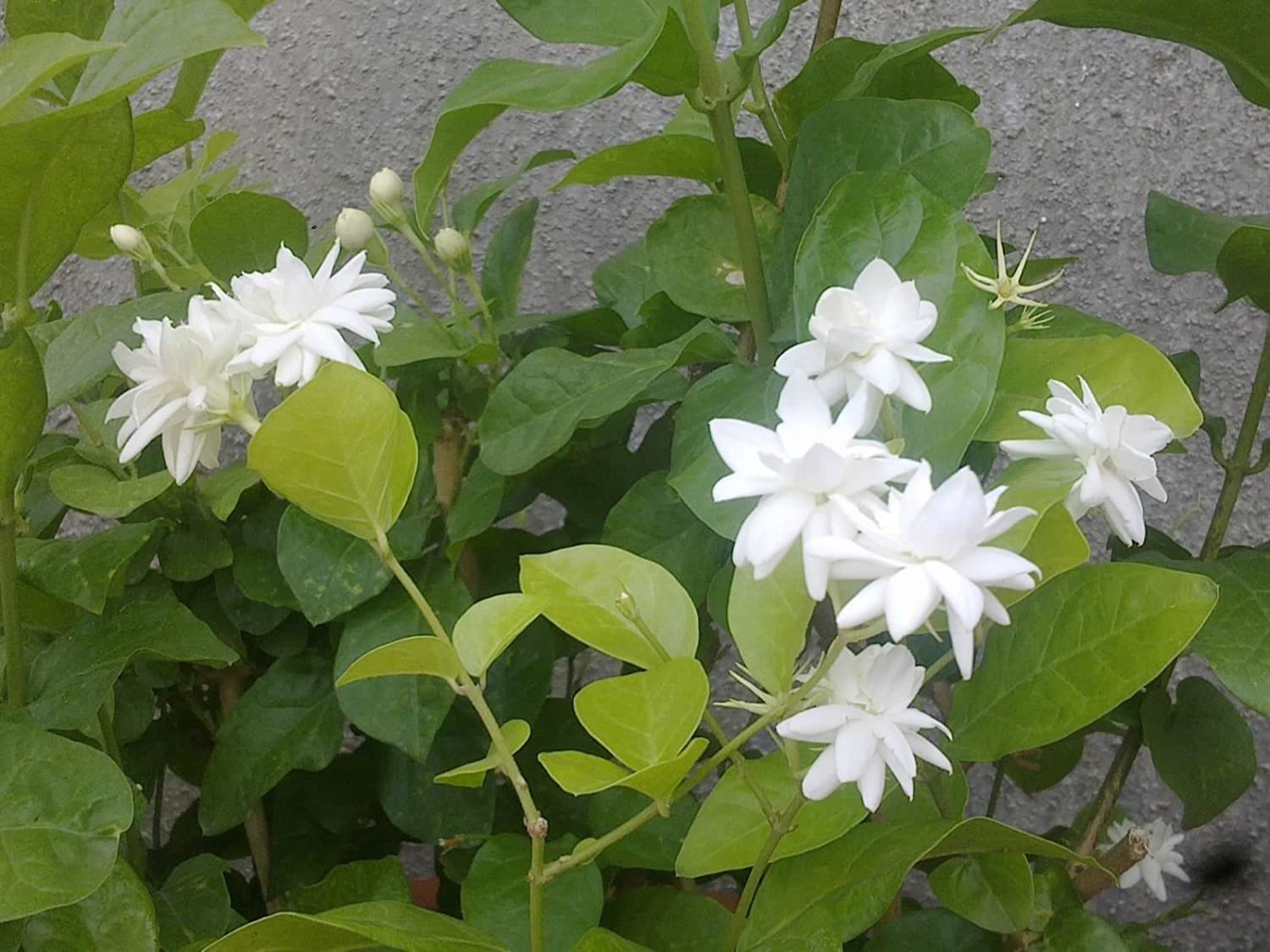
Common jasmine (Jasminum officinale) flowers
Chapter 1
Botanical Profile
Common jasmine is a vigorous, twining, deciduous to semi-evergreen climber of the olive family (Oleaceae), reaching 3–10 metres, with slender, green, angular stems. Its opposite, pinnate leaves are made of 5–9 sharply pointed leaflets, 2–7 cm long, with a longer terminal leaflet. It is native to the Himalaya, Kashmir and the Himalayan foothills, and westwards to Afghanistan, Iran and the Caucasus, and has been grown in gardens across Asia and Europe for many centuries.
The flowers grow in loose clusters of 2–10 at the shoot tips. The buds are tinged with pink and open into pure white, tubular flowers with five spreading, pointed lobes like a small star, 2–2.5 cm across. They bloom from early summer to early autumn, and their intensely sweet scent is strongest in the evening and at night, when the flowers attract their moth pollinators. The fruits are small, black, shiny berries, rarely produced. The scent comes from a complex mix of compounds, including benzyl acetate, linalool, indole and the jasmonates. Leaves contain secoiridoids and flavonoids.
Illustration: a twining stem with pinnate leaves, pink-tinged buds and star-shaped flowers
| Feature | Description |
|---|---|
| Family | Oleaceae (olive family) |
| Habit | Twining climber, 3–10 m; deciduous to semi-evergreen; slender green stems |
| Leaves | Opposite, pinnate, with 5–9 sharply pointed leaflets; the end leaflet is longest |
| Flowers | White (pink-tinged buds), tubular with five spreading lobes, 2–2.5 cm; loose clusters; very fragrant, especially at night; summer to autumn |
| Fruit | Small black berry, rarely produced |
| Key constituents | Benzyl acetate, linalool, indole, methyl jasmonate, cis-jasmone; secoiridoids and flavonoids |
| Home | Himalaya, Kashmir, Afghanistan, Iran and the Caucasus; widely cultivated in warm and temperate gardens |
| Jasmine of India | Botanical name | Sanskrit / common names |
|---|---|---|
| Common or poet’s jasmine | Jasminum officinale | Jati, Sumana; Chameli |
| Spanish jasmine | Jasminum grandiflorum | Jati, Malati; Chameli, Jaji; the main perfume jasmine |
| Arabian jasmine | Jasminum sambac | Mallika; Mogra, Madurai Malli |
| Juhi, cluster jasmine | Jasminum auriculatum | Yuthika; Juhi |
False jasmines. “Carolina jessamine” (Gelsemium sempervirens) is highly poisonous. “Star jasmine” (Trachelospermum jasminoides) and “night-blooming jasmine” (Cestrum nocturnum) are not true jasmines. Always check the botanical name.
Chapter 2
Names in Sanskrit & Their Meaning
| Sanskrit | Transliteration | Meaning |
|---|---|---|
| जाति | Jati | The classical Ayurvedic name for the common and Spanish jasmines; the word also means “kind, species, true birth” |
| मालती | Malati | A classical name for fragrant jasmine, also the heroine of the Sanskrit play Malati-Madhava |
| सुमना | Sumana | “Of good mind”, a word that also means a beautiful flower |
Regional names: Chameli (Hindi, Bengali, Gujarati), Chambeli (Urdu), Jaji (Telugu, Kannada), Jathi malli (Tamil), Jaathi malli (Malayalam), Jai / Jaee (Marathi), Common Jasmine, Poet’s Jasmine, Jessamine (English). The word jasmine comes from the Persian yasmin, popularly rendered “gift from God”.
Chapter 3
Mythology & Cultural Significance
Arrow of Kamadeva
Jasmine is one of the five flowery arrows of Kamadeva, god of love, along with the Ashoka blossom, white and blue lotus and mango blossom. Sanskrit poets call it a flower of moonlit nights and longing.
Malati in Sanskrit Poetry
The Sanskrit poet Bhavabhuti named his play Malati-Madhava after the jasmine, whose heroine is the beautiful Malati, and the flower recurs throughout classical love poetry as a symbol of freshness, youth and delight.
The Gajra and the Bride
Garlands (gajra) of jasmine in women’s hair are a classic sight in South and West India. At weddings, the bride and groom exchange jasmine garlands, and the flowers fill the wedding hall with scent.
Offering to the Gods
Jasmine flowers are offered to Vishnu, Shiva, Krishna and the Goddess in temples, and white jasmine is among the purest flowers of worship.
The Himalayan Flower, National Flower of Pakistan
Jasmine (Chambeli) is the national flower of Pakistan, and the floral wreath on the national emblem is a jasmine garland. In Persian and Mughal gardens, such as the great gardens of Kashmir, it was a favourite climber.
The Perfumer’s Queen
Jasmine absolute, called the “king of oils” in perfumery, is made from flowers picked by hand at dawn, when their scent is strongest. In India, jasmine attar, such as the famous attars of Kannauj, is a traditional perfume.
Flower of a Nation’s Spring
The name has travelled far. Tunisia’s 2011 uprising was nicknamed the “Jasmine Revolution”, and Damascus is called the “City of Jasmine”.
Chapter 4
Esoteric & Energetic Understanding
In spiritual interpretation, jasmine is the flower of pure, moonlit love. These are traditional and symbolic associations, not scientific claims.
- Sattva and purity: white jasmine is the most sattvic of flowers, associated with a pure, calm and devoted mind.
- Moon and Venus: opening at dusk and night, it is linked with the Moon (Chandra) and Venus (Shukra), the planets of the mind, beauty and love.
- Anahata and Svadhishthana: its sweetness is linked with the heart and sacral centres of love, tenderness and sensual joy.
- Gandha, the sense of smell: in Indian thought, fragrance belongs to the earth element, and jasmine’s scent is a way the divine enters the senses.
- Love that blooms in the dark: its scent is strongest after sunset, a symbol of tenderness that appears in quiet and darkness.
Some sweetness opens only at night.
Chapter 5
Ayurvedic Uses
The flowers, leaves and roots are used. In Ayurveda, Jati is best known for its leaves, flowers and oil, and for the wound-healing formulations Jatyadi Taila and Jatyadi Ghrita.
Ayurvedic Profile
- Rasa: Tikta (bitter), Kashaya (astringent), Madhura (sweet)
- Guna: Laghu (light)
- Dosha: commonly described as balancing Pitta and Kapha, with a soothing effect
- Action: Vrana-ropana (wound-healing), Mukha-roga-hara (for mouth ailments)
- Note: sources differ on its potency (virya)
Traditional Uses
- Leaves chewed or used as a rinse for mouth ulcers and sore gums
- Wounds and non-healing ulcers, as in Jatyadi Taila
- Jasmine oil for headache, skin and scalp, and in massage
- Flowers for eye and skin complaints
- Aroma for calm, mood and sleep
- Traditional topical use of flowers to help dry up breast milk (stanya shoshana)
Classical Preparations
- Jatyadi Taila (medicated oil) for wounds
- Jatyadi Ghrita (medicated ghee) for ulcers
- Jati Taila (jasmine oil)
- Jasmine tea (green or white tea scented with the flowers)
Science So Far
Laboratory studies report antimicrobial, anti-inflammatory and wound-healing effects for jasmine leaf preparations, and small human studies suggest the scent may lift mood and reduce stress. Evidence is limited, so the uses remain largely traditional.
Health note. Jasmine oil and absolute can cause allergic skin reactions, so always dilute and patch-test, and never swallow them. Strong scent can trigger headaches or asthma in sensitive people. Flowers used to dry up milk should not be used by mothers who want to continue breastfeeding. Jasmine oil is best avoided in early pregnancy. Please see a doctor for non-healing wounds. Consult a qualified practitioner before using jasmine medicinally.
Chapter 6
Jasmine Flower Remedy
In flower-remedy practice, a remedy is a subtle, energetic preparation made from the flower’s imprint in water, not an herbal extract. Jasmine is approached as the flower of tenderness, sweetness and self-love.
Emotional States
- Feeling unlovable, or guarded about love and closeness
- Loss of joy, sweetness or sensual ease
- Anxious, restless evenings and trouble unwinding
- Being harsh with oneself
Positive Qualities
- Tenderness and self-love
- Gentle, sensual ease and joy
- Peaceful evenings and restful sleep
- Open, trusting, devotional love
Flower remedies are a complementary, spiritual approach. There is insufficient scientific evidence that they treat emotional or physical health conditions, and they should not replace medical or psychological care.
Chapter 7
In the Company of Jasmine
A jasmine vine on a veranda at dusk fills the whole evening with sweetness, and moths hover at the flowers in the dark. People often describe the following (personal experiences, not guaranteed effects):
Emotional
Tenderness and ease, as if the heart is being gently opened.
Mental
A softening of the day’s worries, and a calm, dreamy focus.
Spiritual
Devotion, purity and a feeling of moonlit stillness.
Simple Practices
- Dusk sitting: sit near a jasmine at sunset, breathe in the scent slowly, and let the day dissolve.
- A garland offering: thread a few flowers for the altar or for a loved one.
- Float a flower: place a few blossoms in a bowl of water by your bed or table, and let them scent the room for an evening.
- Mind the strength: if the scent is overpowering, keep the vine outdoors, as in a closed bedroom it can cause headaches.
- Grow it: plant a cutting by a trellis or wall, in sun to part shade and in well-drained, moderately rich soil. Water in dry spells and prune after flowering. Plant it near a seat or window, so that its evening scent reaches you.
Flowers are conscious, intelligent forces.
Explore Aum Himalaya’s Indian flower remedies for body, mind and emotions.
Shop Remedies Flowers Database