
Need Help? +91 908-239-7306 / support@aumhimalaya.com
Flower Database
Bougainvillea · Paper Flower
Bougainvillea glabra Choisy · B. spectabilis Willd. · Kagaz ka Phool · Baganbilas
The cloak of colour on India’s walls, gates and courtyards. What looks like a flower is a set of papery bracts, and the real flower is a tiny cream tube hidden at its heart. It is a plant of the Americas that has become the very picture of an Indian summer.
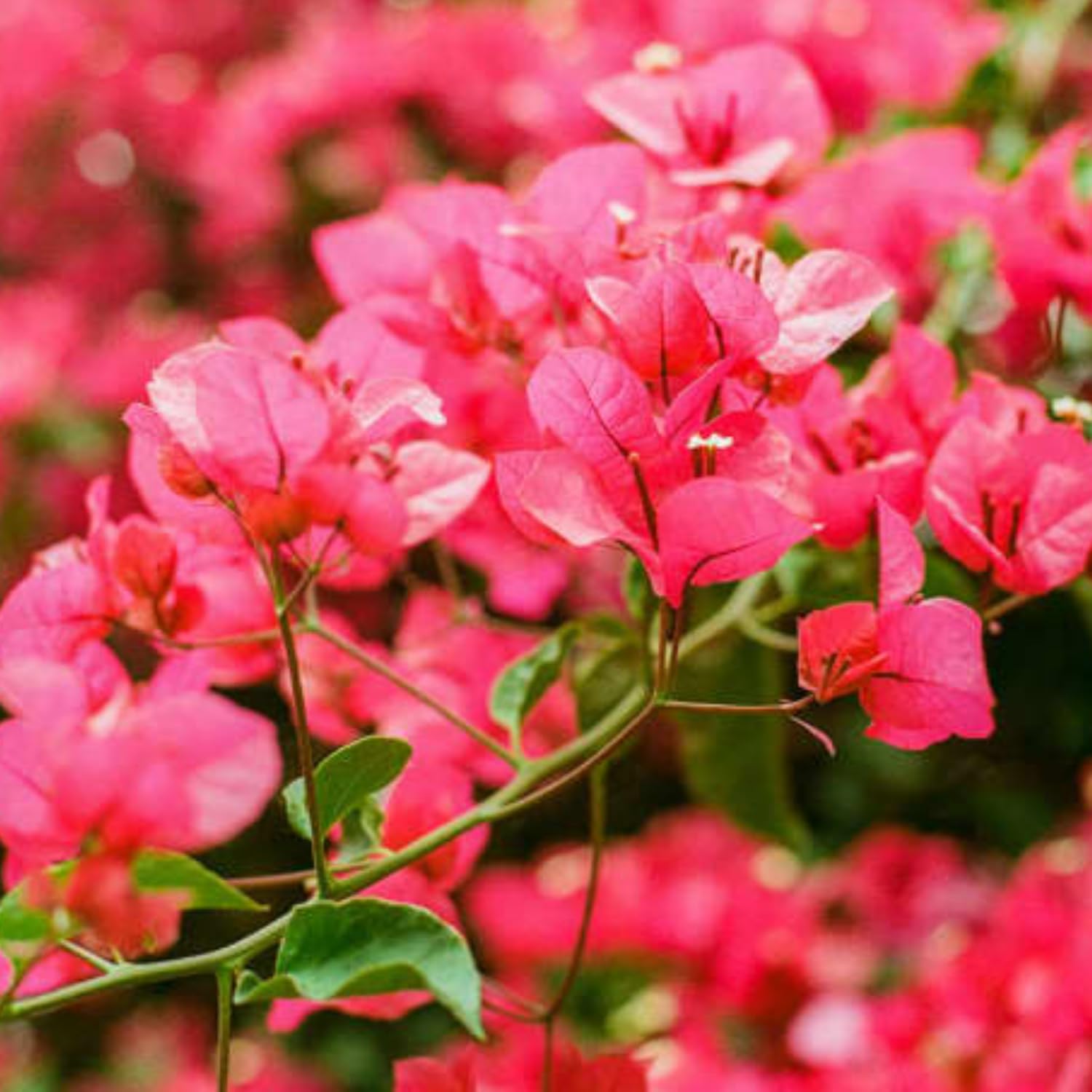
Bougainvillea (Bougainvillea glabra).
Chapter 1
Botanical Profile
Bougainvillea is a thorny, woody, evergreen to semi-deciduous climbing shrub of the four-o’clock family (Nyctaginaceae). It sprawls or climbs to 3–12 metres, holding on to supports with its hooked thorns. The two species most grown are Bougainvillea glabra (the “lesser” bougainvillea, with five-angled flower tubes and short bracts) and B. spectabilis (the “great” bougainvillea, larger and velvety), plus many hybrids. All are native to South America, from Brazil to Peru and Argentina.
The colour is not in the petals. The true flowers are tiny, tubular and cream or white, growing in groups of three. Each is wrapped by a large, thin, papery bract, so each cluster shows three bracts in magenta, pink, red, orange, yellow, white or purple. The bract pigments are betalains, the same family as the colour of beetroot. They remain on the plant for weeks, which is how it earned the name paper flower. Bees, butterflies, sunbirds and hummingbirds visit the small flowers, and the plant blooms best in strong sun with a little dryness.
Illustration: three papery bracts around the tiny cream flowers
| Feature | Description |
|---|---|
| Family | Nyctaginaceae (four-o’clock family) |
| Habit | Thorny, woody climber or sprawling shrub, 3–12 m; evergreen to semi-deciduous |
| Leaves | Simple, alternate, oval to lance-shaped, 5–13 cm |
| True flowers | Tiny (about 2 cm tube), cream-white, three together |
| Bracts | Large, papery and showy, in groups of three; magenta, pink, red, orange, yellow, white |
| Key constituents | Betalain pigments, pinitol, flavonoids, tannins, alkaloids (leaves and bracts) |
| Habitat | Sunny, well-drained sites; drought-tolerant; walls, gates, fences and containers |
Handle with care. The thorns are sharp and the sap and pollen can irritate sensitive skin. Wear gloves when pruning.
Chapter 2
Names & Their Meaning
No classical Sanskrit name. Bougainvillea is a plant of the Americas that reached India only in the last two centuries, so it has no classical Sanskrit name and appears in no classical Ayurvedic text. Its names below are Indian-language names that have grown up since.
| Name | Language | Meaning |
|---|---|---|
| Bougainvillea | Botanical genus | Named after Louis-Antoine de Bougainville, the French admiral on whose voyage the plant was found |
| कागज़ का फूल | Hindi: Kagaz ka phool | “Paper flower”, for the thin bracts |
| বাগানবিলাস | Bengali: Baganbilas | “Garden delight” (bagan, garden, plus bilas, from Sanskrit vilasa, pleasure) |
| காகிதப்பூ | Tamil: Kaagitha poo | “Paper flower” |
| కాగితం పువ్వు | Telugu: Kagitam puvvu | “Paper flower” |
| ಕಾಗದ ಹೂವು | Kannada: Kagada hoovu | “Paper flower” |
| കടലാസ് പൂവ് | Malayalam: Kadalasu poovu | “Paper flower” |
Marathi and Gujarati gardeners often say Bugenvel or Baganvel. In Argentina and Uruguay it is called Santa Rita. Local names vary from place to place.
Chapter 3
Story & Lore
Bougainvillea has no ancient Indian myth, but it has a story of its own.
The Voyage of Discovery
In the 1760s, a French expedition led by Louis-Antoine de Bougainville sailed around the world. Its botanist, Philibert Commerson, found the plant in Brazil and named the genus in the admiral’s honour.
Jeanne Baret
Commerson’s assistant, Jeanne Baret, joined the voyage disguised as a man, and became the first woman known to sail around the world. She is widely credited with collecting plants in South America, perhaps including the bougainvillea, though this is not documented for certain.
Arrival in India
The plant came to Indian gardens in the colonial era, and loved the heat. Today it covers walls, gates, flyovers and verandahs in nearly every city and village, a plant that now seems part of the Indian landscape.
“Kagaz ke Phool”
In Hindi, “paper flowers” also means things that look bright but have no fragrance or substance. It is the title of Guru Dutt’s classic 1959 film about the fleeting nature of fame.
A Plant of Resilience
Bougainvillea blooms most when it is slightly dry and stressed. This gives it a popular reputation as a plant that flowers in hardship.
Chapter 4
Symbolism & Energetic Understanding
As a modern arrival, Bougainvillea has no classical esoteric tradition. The following are contemporary, symbolic readings, not traditional doctrine or scientific claims.
- The flower inside the colour: the true flower is tiny and quiet, wrapped in brilliant display. It invites us to ask what is real and what is show.
- Paper and impermanence: thin, light bracts fall easily and renew, a reminder that beauty is fleeting.
- Blooming in adversity: its best display comes in heat and dryness, a symbol of joy and resilience under pressure.
- Thorns and beauty: a flower with protection built into it, a symbol of healthy boundaries.
- Heart and sacral centres: magenta, pink and orange are often linked with Anahata (heart) and Svadhishthana (sacral) energy, bringing warmth, vitality and joy.
The brightest colours often wrap the quietest flowers.
Chapter 5
Traditional & Folk Uses
Bougainvillea is not described in classical Ayurveda, so no classical rasa, virya or dosha profile exists for it, and we do not assign one. It has a place in folk medicine in India, Latin America and elsewhere.
Folk Uses
- Flower or bract tea for cough, cold and sore throat, a well-known home remedy in Latin America
- Leaf decoctions for loose stools and stomach upset
- Leaf preparations for blood sugar, in folk use
- Poultices and washes for minor skin troubles
Science So Far
Leaf extracts, especially from B. spectabilis, contain pinitol and have shown blood-sugar-lowering, anti-inflammatory, antimicrobial and antioxidant effects in laboratory and animal studies. Human trials are lacking, so these uses remain folk uses.
Other Uses
- Natural betalain pigments for dyes and colouring
- Hedges, living fences and security barriers, thanks to the thorns
- A bonsai favourite
Health note. Bougainvillea is not a standard medicinal plant, and its safety is not well studied. Sap and pollen may cause skin irritation or allergy in some people, and teas may affect blood sugar. Do not use it in place of treatment for cough that persists, diabetes or any serious condition, and consult a qualified practitioner first, especially in pregnancy and breastfeeding.
Chapter 6
Bougainvillea Flower Remedy
In flower-remedy practice, a remedy is a subtle, energetic preparation made from the flower’s imprint in water, not an herbal extract. Bougainvillea is approached as the flower of authentic radiance and resilient joy.
Emotional States
- Putting on a bright front while feeling something else inside
- Fear of showing one’s true self
- Feeling dull, invisible or drained of joy
- Struggling to bloom in a difficult or dry season of life
Positive Qualities
- Authentic self-expression
- Joy and exuberance without pretence
- Resilience and flowering through hardship
- Healthy, protective boundaries
Flower remedies are a complementary, spiritual approach. There is insufficient scientific evidence that they treat emotional or physical health conditions, and they should not replace medical or psychological care.
Chapter 7
In the Company of Bougainvillea
A wall or archway of bougainvillea in full bloom is a sight that lifts the mood, with bees, butterflies and sunbirds busy among the colours. People often describe the following (personal experiences, not guaranteed effects):
Emotional
Cheer and lightness, a feeling of colour and warmth soaking in.
Mental
Fresh energy and inspiration, a good plant to sit near when creative.
Spiritual
A reminder to be real beneath the show, and to flourish in whatever season you are in.
Simple Practices
- Colour gazing: rest your eyes on a cluster for a few minutes and let the colour fill your attention.
- Look for the true flower: find the tiny cream flower inside the bracts, and ask what is the quiet truth at the heart of your own day.
- Prune with care: after a flush of blooms, trim lightly (wearing gloves), as a small ritual of letting go.
- Grow it: give it full sun (at least six hours), well-drained soil and modest water. A little dryness brings the most flowers. Take care with its roots when repotting.
- Gather fallen bracts and use them in a bowl of water or on a puja plate as a simple offering of colour.
Flowers are conscious, intelligent forces.
Explore Aum Himalaya’s Indian flower remedies for body, mind and emotions.
Shop Remedies Flowers Database