
Need Help? +91 908-239-7306 / support@aumhimalaya.com
Flower Database
Drumstick Tree · Moringa
Moringa oleifera Lam. · Shigru · Sahjan · Horseradish Tree
शिग्रु · The tree that feeds a village. Its long pods star in every sambar, its leaves nourish mothers and children, its seeds clear muddy water, and its fragrant white flowers, little known outside India, are cooked in Kerala, Bengal and the Deccan.
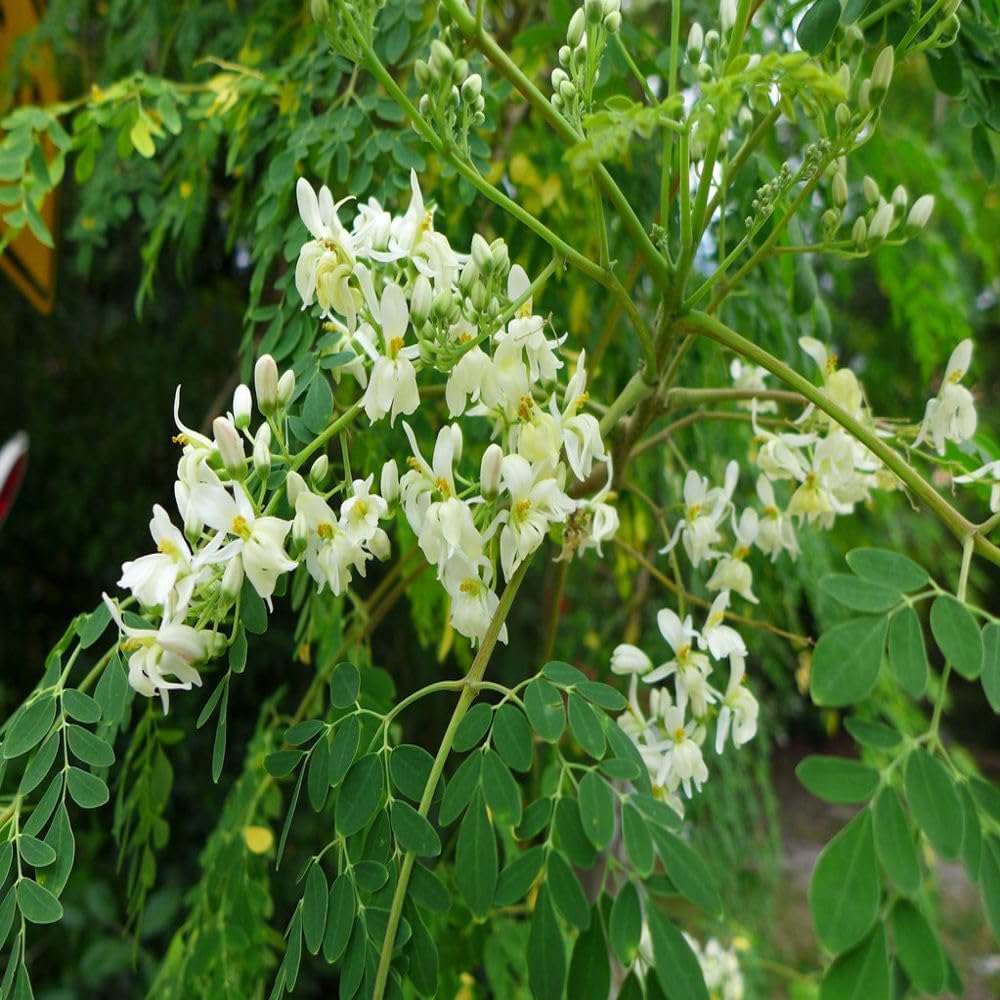
Drumstick tree (Moringa oleifera) flowers
Chapter 1
Botanical Profile
Moringa is a fast-growing, slender, soft-wooded, drought-hardy tree of the small family Moringaceae, usually 5–10 metres tall, with a thick tuberous taproot that tastes of horseradish, corky grey bark and an open, feathery crown. It is native to the sub-Himalayan foothills of north-west India and Pakistan and is now grown throughout the tropics. India is the world’s largest producer. Its huge, delicate leaves, 20–70 cm long, are tripinnate, divided three times into dozens of small oval leaflets.
The flowers hang in loose, drooping clusters (panicles) 10–25 cm long. Each fragrant flower is cream to white, about 1–3 cm across, with five narrow, spreading petals, a delicate yellow-dotted throat and five stamens. They are visited by bees and other insects, and many varieties bloom once or twice a year, while improved perennial types in southern India can flower for much of the year. After pollination the flowers develop into long, slender, three-ribbed pods, the “drumsticks”, 20–60 cm long, with winged seeds. The leaves, flowers, pods, seeds and roots are all rich in protective plant compounds, including flavonoids and the pungent isothiocyanates, which give moringa its horseradish bite.
Illustration: tripinnate leaves, clusters of five-petalled flowers and a drumstick pod
| Feature | Description |
|---|---|
| Family | Moringaceae (a small family of 13 species) |
| Habit | Fast-growing, soft-wooded tree, 5–10 m; thick tuberous taproot; deciduous to semi-evergreen |
| Leaves | Tripinnate, 20–70 cm long, with many small oval leaflets |
| Flowers | Fragrant, cream-white, 1–3 cm; five narrow spreading petals; in drooping panicles; insect-pollinated |
| Fruit | Long, slender, three-sided pod (“drumstick”), 20–60 cm, with seeds |
| Key constituents | Isothiocyanates (glucomoringin), flavonoids (quercetin, kaempferol), phenolic acids, vitamins and minerals in leaves |
| Habitat | Warm, sunny, dry to moist tropical regions; thrives in poor, well-drained soil; frost-tender |
A tree that cleans water. Crushed moringa seeds contain proteins that bind and settle the muddy particles in cloudy water, and they are used in some villages as a natural water clarifier. This does not make water safe to drink on its own, and it should be boiled or otherwise disinfected.
Chapter 2
Names in Sanskrit & Their Meaning
| Sanskrit | Transliteration | Meaning |
|---|---|---|
| शिग्रु | Shigru | The classical Ayurvedic name for the drumstick tree, found in the early medical texts |
| शोभाञ्जन | Shobhanjana | “Beautiful ointment” (shobha, beauty, plus anjana, eye ointment or collyrium) |
| तीक्ष्णगन्ध | Tikshnagandha | “Sharp-smelling”, for the pungent aroma of the plant |
Regional names: Sahjan / Sahijan / Saijan (Hindi), Sojne (Bengali), Shevga (Marathi), Saragvo (Gujarati), Murungai (Tamil), Munaga (Telugu), Nugge (Kannada), Muringa (Malayalam), Moringa, Drumstick and Horseradish Tree (English). The genus name Moringa comes from the Tamil and Malayalam murungai / muringa, meaning “twisted pod”.
Chapter 3
Mythology & Cultural Significance
Moringa has few Puranic tales, but it is a living heart of Indian food and village life.
The Sambar Staple
The drumstick pod is a signature of South Indian cooking, where sambar without it is hard to imagine. The pods are also used in curries, kootu and aviyal, and the leaves in thoran, poriyal and parathas.
Eating the Flowers
The blossoms are cooked as a vegetable in several regions: muringa poo thoran in Kerala, sojne phool fritters and stir-fries in Bengal and Odisha, and munaga puvvu dishes in Andhra. They have a mild, slightly bitter, mushroom-like flavour.
In the Ancient Texts
Shigru appears in the classical Ayurvedic works of Charaka and Sushruta, which recognise different forms, and the name Shobhanjana hints at its use for the eyes. It was valued as a pungent, warming plant for the digestive system and swellings.
Ben Oil of the Ancients
Oil pressed from the seeds, known as ben oil, was prized in ancient Egypt and Rome as a perfumer’s oil that stays fresh without going rancid.
A Nutrition Tree
Because moringa leaves are rich in protein, iron, calcium and vitamins, nutrition programmes in India and Africa promote it in kitchen gardens to fight malnutrition and anaemia, earning it the name “miracle tree” and “tree of life”.
The Cutting Tree
Moringa grows easily from cuttings, and it is common for neighbours to share a branch to start a new tree, a small, everyday act of generosity.
Chapter 4
Esoteric & Energetic Understanding
In spiritual interpretation, moringa is the tree of nourishment and generosity. These are traditional and symbolic associations, not scientific claims.
- Muladhara (root chakra): a plant that thrives in poor, dry ground and feeds its community is a symbol of security and basic abundance.
- Shobhanjana, the beautiful ointment: the name links the tree to clear sight and to Ajna, the third-eye centre of insight.
- Pungent clarity: its sharp, warming nature is symbolically a clearing of heaviness, lethargy and stuck feelings.
- Giving freely: leaf, flower, pod, seed and root all give nourishment, a model of generosity.
- Resilience: cut it back and it grows again, a symbol of renewal after loss.
Plant one tree and a whole household is fed.
Chapter 5
Ayurvedic Uses
The leaves, flowers, pods, seeds, root bark and gum are all used. Shigru is described in classical texts, and its leaves and pods are a regular part of the diet.
Ayurvedic Profile
- Rasa: Katu (pungent), Tikta (bitter)
- Guna: Laghu (light), Ruksha (dry), Tikshna (sharp)
- Virya: Ushna (warming)
- Vipaka: Katu
- Dosha: balances Kapha and Vata; may increase Pitta in excess
Traditional Uses
- Sluggish digestion, worms and loss of appetite
- Kapha conditions: swelling, heaviness, cough and excess weight
- Joint pain and stiffness, with external applications
- Postnatal nourishment and milk support, with the leaves and flowers
- Flower tea or decoction as a tonic for colds and urinary complaints
- Eye care, as the name Shobhanjana suggests
Formulations
- Shigru Churna (leaf or root bark powder)
- Shigru Guggulu for joint complaints
- Fresh leaf and pod dishes as everyday food-medicine
Science So Far
Moringa leaves are an excellent source of protein, iron, calcium and vitamins A and C. Laboratory studies show antioxidant and anti-inflammatory activity in leaf and flower extracts, and some small human trials suggest modest benefits for blood sugar, cholesterol and breast-milk supply. Results are mixed, and quality varies.
Health note. Moringa leaves, pods and flowers as food are generally safe. The root, bark and concentrated extracts contain compounds that may be harmful in large amounts and may stimulate the uterus, so they should be avoided in pregnancy. Moringa may lower blood sugar and blood pressure, so check with your doctor if you take medicines for these or for thyroid conditions. Too many pods or too much powder may cause gas or loose stools. Powders should come from tested sources, as quality and contamination vary. Consult a qualified practitioner before therapeutic use.
Chapter 6
Moringa Flower Remedy
In flower-remedy practice, a remedy is a subtle, energetic preparation made from the flower’s imprint in water, not an herbal extract. Moringa is approached as the flower of nourishment, vitality and generous resilience.
Emotional States
- Feeling depleted, undernourished or running on empty
- Burnout from caring for others and neglecting oneself
- Heaviness, sluggishness and low motivation
- Feeling that there is “not enough” to give
Positive Qualities
- Renewed vitality and strength
- Self-nourishment and care
- Generosity without exhaustion
- Resilience and growth from simple roots
Flower remedies are a complementary, spiritual approach. There is insufficient scientific evidence that they treat emotional or physical health conditions, and they should not replace medical or psychological care.
Chapter 7
In the Company of the Moringa Tree
A moringa tree in bloom, in the courtyard or at the edge of a field, hums with bees, and its soft, honeyed scent fills the morning air. People often describe the following (personal experiences, not guaranteed effects):
Emotional
Warmth and a sense of being provided for, like a home kitchen.
Mental
Lightness and a clear head in the morning air, with a gentle sweetness to the day.
Spiritual
Gratitude for simple nourishment and for a tree that gives so freely.
Simple Practices
- Morning breath: stand near the tree when it blooms and breathe in its fragrance slowly, three times.
- Mindful meal: cook drumstick or its flowers with attention, and offer thanks for the farmers and the tree.
- Share a cutting: pass a branch to a neighbour to start a new tree.
- Watch the bees: the flowering season is a good time to sit quietly and watch pollinators.
- Grow one: plant a cutting or seed in full sun and well-drained soil, avoid waterlogging, and prune it back to keep it low for easy harvest. Branches are brittle, so avoid parking under it in storms.
Flowers are conscious, intelligent forces.
Explore Aum Himalaya’s Indian flower remedies for body, mind and emotions.
Shop Remedies Flowers Database