
Need Help? +91 908-239-7306 / support@aumhimalaya.com
Flower Database
Brahmi · Water Hyssop
Bacopa monnieri (L.) Wettst. · Herb of Grace · Jal Brahmi · Nir-Brahmi
ब्राह्मी · The herb of the creator’s intelligence. A small creeping plant of marshes and ditches, named for Brahma and linked with Saraswati, which Indian students and sages have turned to for memory, calm and clear thought for thousands of years.
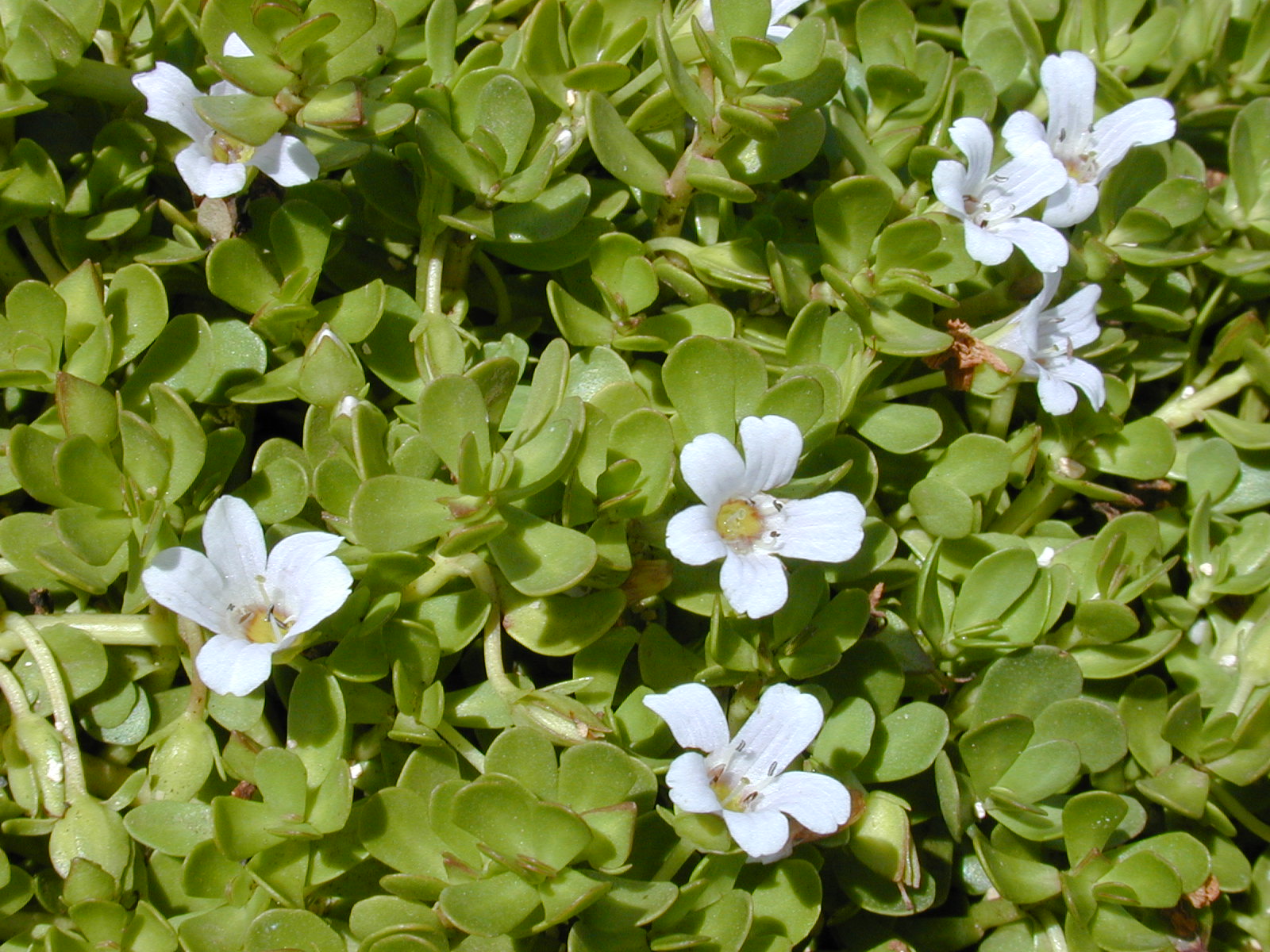
Brahmi (Bacopa monnieri).
Chapter 1
Botanical Profile
Brahmi is a small, soft, creeping perennial herb of wet places, in the plantain family (Plantaginaceae; older books place it in Scrophulariaceae). Its prostrate, branching stems root at the nodes and spread through marshes, paddy-field edges, ponds and stream banks across tropical Asia, from the plains up to about 1,300 m, and the plant occurs widely in warm regions around the world. It also grows happily in aquariums and in pots kept wet.
The leaves are small, fleshy, oblong to spoon-shaped, 0.6–2 cm long, in opposite pairs along the stem, and speckled with tiny glands. They are not noticeably fragrant. The flowers are solitary, borne in the leaf axils on slender stalks, bell-shaped with five lobes, about 5–9 mm long, white to pale blue or lilac with fine violet veins. In India the plant can flower for much of the year. The fruit is a tiny capsule. Its active compounds include the bacosides, triterpene saponins, along with alkaloids such as brahmine and herpestine and flavonoids.
Illustration: creeping stem with fleshy leaves and the bell-shaped flower
| Feature | Description |
|---|---|
| Family | Plantaginaceae (formerly Scrophulariaceae) |
| Habit | Creeping, succulent perennial herb; roots at the nodes; marsh and water-edge plant |
| Leaves | Small, fleshy, opposite, oblong to spoon-shaped, 0.6–2 cm; gland-dotted |
| Flowers | Solitary, in leaf axils; bell-shaped, 5 lobes; white to pale blue or lilac, veined |
| Fruit | Small ovoid capsule |
| Key compounds | Bacosides A and B, bacopasides, alkaloids (brahmine, herpestine), flavonoids |
| Habitat | Wet, sunny to part-shade margins of ponds, ditches, rice fields; tropical and subtropical regions |
Two “Brahmis”. In much of South India, Brahmi means Bacopa monnieri, while in parts of North and East India the name is also used for Indian pennywort (Centella asiatica, Mandukaparni, Gotu Kola). They are different plants with different properties. Always check the botanical name on a product.
Chapter 2
Names in Sanskrit & Their Meaning
| Sanskrit | Transliteration | Meaning |
|---|---|---|
| ब्राह्मी | Brahmi | “Belonging to Brahma”, the creator; the herb or the power (shakti) of Brahma, linked with creative intelligence |
| सरस्वती | Saraswati | The name of the Goddess of knowledge and speech, also used as a name of the herb |
| इन्द्रवल्ली | Indravalli | “Indra’s creeper”, as given in some regional sources |
| जलशय | Jalashaya | “Dweller in water”, for its marshy habitat, as listed in some regional sources |
Regional names: Brahmi / Jal Brahmi (Hindi, Marathi, Bengali), Neer Brahmi / Neerpirami (Tamil), Jalabrahmi (Kannada), Sambrani chettu (Telugu), Brahmi / Nirbrahmi (Malayalam), Water Hyssop and Herb of Grace (English).
Chapter 3
Mythology & Cultural Significance
Brahmi has few dramatic Puranic tales, but it belongs to a long, living tradition of learning.
The Creator’s Herb
The name connects the plant to Brahma, the creator and source of the Vedas. In tradition, this is the herb that awakens the creative intellect.
Saraswati, Goddess of Learning
The herb is also associated with Saraswati, goddess of knowledge, music and speech, and is considered an apt plant for students and scholars.
Medhya: Food for the Mind
In Ayurveda, Brahmi is classed as medhya, a herb for the intellect, memory and retention. Classical texts such as the Charaka Samhita recommend Brahmi preparations, including Brahmi Ghrita (medicated ghee), for mental disorders and epilepsy.
The Student’s Tonic
Tradition holds that young students of the Vedic schools were given Brahmi to help them memorise long hymns. In many Indian homes, Brahmi oil is still massaged into children’s scalps before exams.
Himalayan Seekers
Brahmi has long been taken by meditators and seekers, who treasure it as a sattvic (calm and pure) plant that supports concentration and a clear mind.
Chapter 4
Esoteric & Energetic Understanding
In spiritual interpretation, Brahmi is the herb of the clear, still mind. These are traditional and symbolic associations, not scientific claims.
- Ajna and Sahasrara (third eye and crown): the centres of insight and higher awareness are traditionally linked with Brahmi’s mind-clearing nature.
- Sattva: a sattvic herb, associated with clarity, calm and balance.
- Creative intelligence: as Brahma’s herb, it stands for the creative mind and the ability to retain and use knowledge wisely.
- Humble roots in water: a tiny creeper that grows in mud and bears pale flowers, a teaching that wisdom is quiet and rooted.
- Memory as lineage: remembering is a sacred act in India’s oral traditions, and Brahmi is the plant of that remembering.
A still mind sees clearly.
Chapter 5
Ayurvedic Uses
The whole above-ground plant (panchanga), especially the leaf and stem, is used, fresh as juice or dried as powder, tea, oil and ghee. Brahmi is one of the most important medhya rasayana herbs.
Ayurvedic Profile
- Rasa: Tikta (bitter), Kashaya (astringent)
- Guna: Laghu (light)
- Virya: Sheeta (cooling)
- Vipaka: Madhura (sweet)
- Dosha: commonly described as balancing all three, especially Vata and Pitta
- Action: Medhya (intellect), Smriti-vardhaka (memory)
Traditional Uses
- Memory, concentration and learning
- Stress, nervous tension and mild anxiety
- Restless sleep and mental fatigue
- Epilepsy and mental disorders (apasmara, unmada), as classical formulations
- Hair and scalp care as a nourishing oil
- Skin complaints and cough, in traditional use
Classical Formulations
- Brahmi Ghrita (medicated ghee)
- Brahmi Vati (tablets)
- Brahmi Taila (oil for head massage)
- Saraswatarishta and Brahmi Churna
Science So Far
Several human trials and reviews suggest that standardised Bacopa extracts, taken for 8–12 weeks, may modestly improve attention and memory. Results vary, and effects take weeks to appear. It is among the better-studied Ayurvedic herbs for the brain, but quality of evidence is still moderate.
Health note. Bacopa may cause nausea, stomach cramps or loose stools, particularly on an empty stomach. It may slow the heart rate and affect thyroid function, and it may interact with sedatives, thyroid medicines and drugs for epilepsy, anxiety or depression. It is traditionally avoided in pregnancy. Do not use it in place of treatment for epilepsy or any mental health condition. Consult a qualified practitioner before use.
Chapter 6
Brahmi Flower Remedy
In flower-remedy practice, a remedy is a subtle, energetic preparation made from the flower’s imprint in water, not an herbal extract. Brahmi is approached as the flower of clear thought and calm focus.
Emotional States
- An overactive, scattered or overthinking mind
- Mental fatigue and difficulty concentrating
- Exam or performance anxiety
- Feeling mentally “foggy” under stress
Positive Qualities
- Clarity, focus and mental calm
- Trust in one’s own intelligence
- Quiet, steady attention
- Receptive, curious learning
Flower remedies are a complementary, spiritual approach. There is insufficient scientific evidence that they treat emotional or physical health conditions, and they should not replace medical or psychological care.
Chapter 7
In the Company of Brahmi
Brahmi is a humble companion: a green carpet along a pond or in a shallow tray by the window. People often describe the following (personal experiences, not guaranteed effects):
Emotional
Quiet and softness, with a sense of being unhurried.
Mental
Fewer racing thoughts and more room to focus, with a good plant to keep near a desk.
Spiritual
Respect for learning and remembering as sacred acts, and for wisdom that grows quietly.
Simple Practices
- Study ritual: before reading or meditating, touch a leaf, take three slow breaths and set one clear intention.
- Remember with gratitude: think of a teacher who shaped you and thank them silently.
- Scalp massage: a gentle head massage with Brahmi oil in the evening, as many families do for children and adults alike.
- Grow it: a shallow tray or pot kept constantly moist, in sun or part shade. It spreads by cuttings and makes a lush ground cover.
- Choose well: buy Bacopa products from reliable makers that name Bacopa monnieri.
Flowers are conscious, intelligent forces.
Explore Aum Himalaya’s Indian flower remedies for body, mind and emotions.
Shop Remedies Flowers Database