
Need Help? +91 908-239-7306 / support@aumhimalaya.com
Flower Database
Champak · Champa
Magnolia champaca (L.) Baill. ex Pierre · syn. Michelia champaca L. · Golden Champa · Sonchafa
चम्पक · The golden flower of the evening. Its scent drifts across temple courtyards at dusk, adorns the hair of brides, perfumes the world’s finest scents and gave its name to Radha’s golden friend Champakalata. It is the flower that, say the poets, no bee will touch.
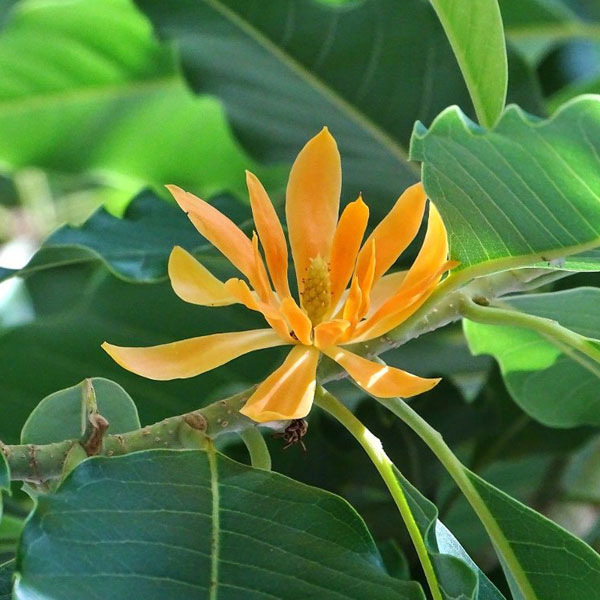
Champak (Magnolia champaca) flower
Chapter 1
Botanical Profile
Champak is a tall, handsome, evergreen tree of the magnolia family (Magnoliaceae). In the wild it can reach 30–50 metres, but garden trees are often 10–20 metres, with a narrow crown, smooth grey-brown bark and glossy, pointed leaves 10–25 cm long. It was long placed in the genus Michelia and is now classified as Magnolia champaca, although the old name is still in everyday use. It is native to the foothills of the Himalaya, north-eastern and southern India, Nepal, Myanmar, southern China and Southeast Asia, and has been planted around temples since antiquity.
The flowers are solitary, borne in the leaf axils, 4–8 cm across, with 12 or more narrow, spiralling tepals (petal-like segments). They open pale yellow and deepen to golden orange as they mature. A white-flowered form (Magnolia × alba, Safed Champa) is also grown. The scent, rich, sweet, and slightly fruity, is strongest at dusk and through the night. Flowering is heaviest in spring and the early monsoon, and light blooms can appear through much of the year. The fruit is a cluster of woody follicles that split to show seeds with bright red-orange coats, eaten by birds. The essential oil contains linalool and related aromatic compounds, and the bark holds the alkaloid liriodenine.
Illustration: the spiralling petals of a champak flower, glossy leaves and seeds
| Feature | Description |
|---|---|
| Family | Magnoliaceae (magnolia family) |
| Habit | Tall evergreen tree, 10–30 m in gardens, up to 50 m in forest; narrow crown, smooth bark |
| Leaves | Glossy, narrowly ovate, pointed, 10–25 cm |
| Flowers | Solitary, 4–8 cm; 12 or more narrow petals; pale yellow turning orange (or white in M. × alba); strongly scented, especially at night |
| Fruit | Cluster of woody follicles; seeds with red-orange coats |
| Key constituents | Essential oil (linalool and aromatic esters), alkaloids such as liriodenine, sesquiterpene lactones such as parthenolide |
| Habitat | Moist evergreen and hill forest, temple groves and gardens; slow to flower from seed |
Not the same as “Champa” in other places. In some regions, the name Champa or Chameli is given to other fragrant flowers. Frangipani (Plumeria) is often called “Champa” or “Temple tree” in North India. Check the botanical name when you buy plants or oils.
Chapter 2
Names in Sanskrit & Their Meaning
| Sanskrit | Transliteration | Meaning |
|---|---|---|
| चम्पक | Champaka | The classical name of the tree and flower; the source of Hindi Champa, Thai Champi and Indonesian Cempaka |
| चम्पेय | Champeya | “Of the champaka”, a classical synonym for the tree or flower |
| हेमपुष्पक | Hemapushpaka | “Golden-flowered” |
Regional names: Champa / Sonchampa (Hindi, Bengali, Odia), Sonchafa (Marathi), Champo (Gujarati), Sampige (Kannada), Sampangi (Telugu), Shenbagam (Tamil), Chempakam (Malayalam), Champi (Thai), Cempaka (Indonesian, Malay), Orange Champak and Golden Champa (English).
Chapter 3
Mythology & Cultural Significance
Champakalata, Radha’s Golden Friend
In Vaishnava tradition, Champakalata is one of the eight chief companions (ashta sakhis) of Radha, said to have a complexion like a golden champak flower. Poets compare golden skin with the champaka, and the flower is among those offered to Krishna.
The Flower the Bees Avoid
A famous convention in classical Sanskrit poetry says that the bumblebee never settles on a champaka. The poets read this as a sign of a beauty so complete it does not need admirers, or of one that can be admired from a distance. In reality, other insects visit it.
Offered in the Temple
Champak flowers are strung in garlands and offered in many temples to Vishnu, Krishna and the Goddess, and the trees are planted in temple compounds. In many places the scent of Champak at dusk is part of the atmosphere of evening worship.
Champapuri
The ancient city of Champa, in the Anga region of present-day Bihar, is traditionally said to be named for its champak trees. It is a sacred place for Jains as the birthplace and liberation site of the twelfth Tirthankara, Vasupujya.
Buddhist Tradition
According to a Tibetan belief, the future Buddha, Maitreya, will attain enlightenment beneath the white flowers of a champaca. In Thailand, the flower is called Champi and is often planted around Buddhist temples.
Across Asia
The flower is part of cultural identity in Indonesia and Malaysia (Cempaka) and in Aceh, where, as Jeumpa, it is the subject of a well-known regional song. It adorns bridal hair across South and Southeast Asia.
The Perfumer’s Jewel
Champaca is one of the most precious flowers in perfumery. Its absolute and attar scent luxury perfumes and traditional hair oils and are used in aromatherapy.
Chapter 4
Esoteric & Energetic Understanding
In spiritual interpretation, Champak is the flower of fragrance as divine presence. These are traditional and symbolic associations, not scientific claims.
- Gandha, the sense of smell: in the Indian system, smell belongs to the earth element, and a sacred fragrance like champak’s is said to bring the divine into the senses.
- Anahata (heart) and Manipura: its golden colour and sweet scent are linked with devotional love (bhakti) and with warmth at the centre of the self.
- Beauty that is complete in itself: the poets’ bee that never lands is a symbol of self-contained, untouched grace.
- Evening fragrance: blooming most sweetly at dusk, it is associated with the transition from day to night, calm and quiet inwardness.
- Gold: radiance, prosperity and the sun’s warmth, offered to the Divine.
Some beauty asks for nothing and still fills the whole evening.
Chapter 5
Ayurvedic & Traditional Uses
Flowers, bark, root, leaves and fruit are all used in Indian and Southeast Asian traditional medicine, and the flower oil is a classic ingredient of aromatic oils and perfumes. Classical texts describe the plant as a cooling, bitter and astringent flower, though exact property lists vary between sources, so we do not give a single fixed profile here.
Traditional Uses
- Flower oil for headaches, joint pain and massage
- Flower preparations for fever, colic, cough and eye irritation
- Bark and root for fever, stomach complaints and, in folk use, menstrual disorders
- Leaf and fruit for digestive discomfort
- Aromatic: hair oils, garlands and perfumery
Science So Far
Studies on the flower, bark and leaf of Champak report antimicrobial, anti-inflammatory and antioxidant activity, linked to compounds such as liriodenine and parthenolide. Almost all work is laboratory or animal research, so uses remain traditional.
Aromatherapy
Champaca absolute is used in diluted form in massage and perfumery, with a rich, sweet, calming floral scent. It is prized for its use in meditation and evening rituals.
Health note. Champak contains sesquiterpene lactones, such as parthenolide, which can cause skin allergy in sensitive people, especially those allergic to plants of the daisy family. Never swallow the essential oil, always dilute it for the skin, and patch-test first. The strong scent can cause headaches or nausea in sensitive people, especially in a closed room at night. Root and bark preparations are traditionally avoided in pregnancy. Consult a qualified practitioner before using any part of the plant medicinally.
Chapter 6
Champak Flower Remedy
In flower-remedy practice, a remedy is a subtle, energetic preparation made from the flower’s imprint in water, not an herbal extract. Champak is approached as the flower of devotional love and radiant self-worth.
Emotional States
- Feeling unloved, unattractive or unseen
- A closed or guarded heart
- Grief and heaviness around love
- Restlessness in the evening and difficulty winding down
Positive Qualities
- Open, devotional love
- Self-worth and quiet radiance
- Gentle sensuality and refinement
- Calm, fragrant inner peace
Flower remedies are a complementary, spiritual approach. There is insufficient scientific evidence that they treat emotional or physical health conditions, and they should not replace medical or psychological care.
Chapter 7
In the Company of the Champak
Standing under a flowering Champak at dusk, the air is thick with sweet scent, and the golden flowers, hidden among dark leaves, are often smelled before they are seen. People often describe the following (personal experiences, not guaranteed effects):
Emotional
Sweetness and tenderness, a feeling of being wrapped in something precious.
Mental
A slowing of thoughts and a gentle turning inward, a good companion for evening reflection.
Spiritual
Devotion, a sense of fragrance as a form of prayer, and an inward stillness.
Simple Practices
- Dusk sitting: sit near a flowering tree at sunset and follow the scent with slow breaths for ten minutes.
- Float a flower: place a fallen bloom in a bowl of water on your altar or table, and let its scent fill the room for an evening.
- Offering: offer one fallen flower with a silent prayer of gratitude.
- Keep it light: in a small, closed room, one flower is plenty, as the scent is strong.
- Plant one: a Champak needs room to grow tall, in rich, well-drained soil and sun, and seedlings are slow, taking many years to flower. An air-layered or grafted plant flowers sooner.
Flowers are conscious, intelligent forces.
Explore Aum Himalaya’s Indian flower remedies for body, mind and emotions.
Shop Remedies Flowers Database