
Need Help? +91 908-239-7306 / support@aumhimalaya.com
Flower Database
Garlic · Lehsun
Allium sativum L. · Lashuna · Rasona · Mahaushadha
लशुन · The great medicine with a famous smell. Garlic has anchored kitchens and Ayurvedic remedies for thousands of years, and Indian tradition tells that it sprang from drops of divine nectar. Its tall flower stalk bears a rarely seen, rarely fertile flower head that mostly forms little bulbs instead of seeds.
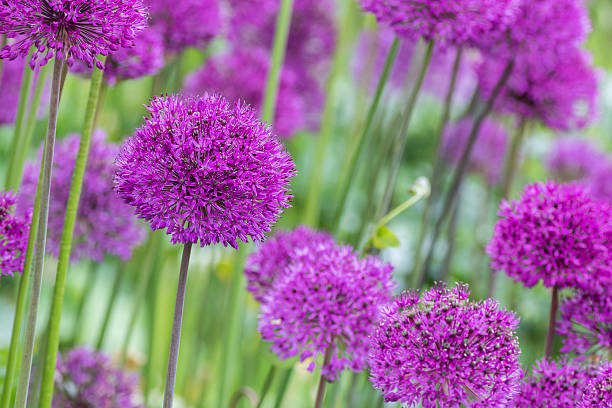
Garlic (Allium sativum) flower head
Chapter 1
Botanical Profile
Garlic is a bulbous perennial, usually grown as an annual, of the onion family (Amaryllidaceae, subfamily Allioideae; older books say Liliaceae or Alliaceae). It has flat, strap-like leaves 30–60 cm long and an underground bulb divided into 8 to 20 papery-wrapped cloves. It was domesticated thousands of years ago in Central Asia and is now grown worldwide. India is the world’s second-largest producer, with Madhya Pradesh, Gujarat and Rajasthan at the front. Its distinctive smell comes from sulphur compounds: whole garlic contains odourless alliin, which turns into pungent allicin when the clove is crushed or chopped.
The flower is a rarity. “Hardneck” kinds send up a tall, solid, often curling flower stalk (the scape), 60–100 cm tall, topped by a papery, beaked bract (the spathe) that encloses a round cluster (an umbel). Inside are a few small white or pinkish-purple six-petalled flowers and, more often, many tiny purple bulbils, little aerial bulbs. Domesticated garlic has largely lost the ability to produce fertile flowers and seed. It reproduces instead by cloves and bulbils, which is why every garlic plant is a clone. Many “softneck” types seldom make a scape at all.
Illustration: the scape with its umbel of bulbils and tiny flowers, and a bulb with cloves
| Feature | Description |
|---|---|
| Family | Amaryllidaceae (onion subfamily Allioideae) |
| Habit | Bulbous perennial grown as an annual; leaves 30–60 cm |
| Bulb | Papery-skinned, with 8–20 cloves |
| Flower stalk | Scape, 60–100 cm, often curling; topped by a papery, beaked spathe |
| Flowers | Few, small, white to pinkish-purple, six tepals; often sterile or replaced by bulbils |
| Bulbils | Tiny purple aerial bulbs in the umbel; edible and can be planted |
| Key constituents | Alliin and allicin, ajoene, diallyl sulphides, flavonoids, saponins |
| Habitat | Sunny, well-drained fields; cool-season crop in India, planted in autumn and harvested in late winter to spring |
Scapes are edible. The tender flower stalks, called garlic scapes, are cut before the umbel opens, which also directs the plant’s energy to the bulb. They have a mild garlic flavour and are eaten in stir-fries, chutneys and pesto.
Chapter 2
Names in Sanskrit & Their Meaning
| Sanskrit | Transliteration | Meaning |
|---|---|---|
| लशुन | Lashuna | The classical Ayurvedic name for garlic, the source of Hindi Lehsun and Marathi Lasun |
| रसोन | Rasona | “Lacking one taste” (rasa-una): classical texts say garlic has five of the six tastes and lacks only sourness |
| उग्रगन्ध | Ugragandha | “Strong-smelling” |
| महौषध | Mahaushadha | “The great medicine” |
| यवनेष्ट | Yavaneshta | “Beloved of the foreigners (Yavanas)”, reflecting that it was relished by outsiders |
Regional names: Lehsun / Lahsun (Hindi, Urdu), Roshun (Bengali), Lasun (Marathi), Lasan (Gujarati), Vellaipoondu (Tamil), Vellulli (Telugu), Bellulli (Kannada), Veluthulli (Malayalam), Garlic (English, from Old English garleac, “spear leek”).
Chapter 3
Mythology & Cultural Significance
Born of the Nectar
A popular legend tells that when Vishnu, as Mohini, struck off the head of the demon Rahu, who had stolen a sip of the divine nectar (amrita), drops of nectar fell to earth and became garlic. This is said to explain both its healing power and its demonic odour, and why strict Brahmins and Vaishnavas avoid it.
The Bower Manuscript
The Bower Manuscript, an early Indian medical text of about the fifth century CE found in Central Asia, opens with a treatise on garlic. It lists dozens of remedies, which shows how important the plant was in ancient Indian medicine.
Sattvic Kitchens and Fasts
In yogic, Vaishnava and Jain traditions, garlic and onion are avoided as rajasic and tamasic (stimulating or heavy), and are left out of temple kitchens, Navratri, Ekadashi and other fasts. Many householders, however, treat it as a daily medicine.
A Shield Against Harm
Across cultures, garlic is a protective plant. In Europe it is the famous guard against vampires, and in many parts of the world a bulb hung at the door is said to keep away the evil eye.
An Ancient Food
Garlic cloves were found in Tutankhamun’s tomb, and tradition says pyramid builders were given it for strength. In Korea, the founding legend of Dangun has a bear and a tiger tested with garlic and mugwort.
The Kitchen Staple
From Rajasthani lehsun chutney to Maharashtrian thecha and South Indian rasam tempering, garlic is in countless regional dishes, and a tempering of garlic in ghee is a sign of home comfort.
Chapter 4
Esoteric & Energetic Understanding
In spiritual interpretation, garlic is a plant of protection, intensity and the fire of transformation. These are traditional and symbolic associations, not scientific claims.
- Rasa-una, one taste missing: a plant of five tastes that lacks only sourness, a teaching that completeness has gaps and strength has a character.
- Agni and Manipura: its heat is linked with digestive fire and willpower at the solar plexus.
- Protection and boundaries: its strong smell acts as a shield in folk belief, a symbol of clear boundaries.
- Tamas and rajas: in yogic thought it is stimulating, so it is valued for work in the world and avoided by those seeking deep stillness.
- The flower that became bulbs: domesticated garlic gave up seed for steadfast cloning, a symbol of persistence, lineage and self-renewal.
Potent medicine is rarely mild.
Chapter 5
Ayurvedic Uses
The bulb (cloves) is the main part used, fresh, cooked, as oil, in milk or as a powder. The leaves and scapes are used as food.
Ayurvedic Profile
- Rasa: five tastes except sour; Katu (pungent) predominant
- Guna: Guru, Snigdha, Tikshna (heavy, unctuous, sharp)
- Virya: Ushna (strongly warming)
- Vipaka: Katu
- Dosha: pacifies Vata and Kapha; increases Pitta
Traditional Uses
- Vata conditions: joint pain, sciatica, stiffness, nervous weakness
- Kapha conditions: cough, cold, asthma and congestion
- Digestive weakness, gas and worms
- Heart and circulation, and high cholesterol (medo-hara)
- Postnatal care and lactation, in cooked preparations
- Earache and skin conditions, in folk use
Classical Preparations
- Lashuna Kshirapaka: garlic simmered in milk
- Lashunadi Vati for digestion
- Lashuna Taila: garlic-infused oil for massage
Science So Far
Trials and meta-analyses suggest that garlic supplements may modestly lower blood pressure and cholesterol, and garlic has antimicrobial activity in the laboratory. Effects are generally small and vary with the preparation, and evidence for preventing colds is limited.
Health note. Garlic as a food is generally safe. In larger amounts it may cause heartburn, gas, breath and body odour. It can slow blood clotting, so check with your doctor if you take blood thinners or aspirin, or before surgery. It can also lower blood pressure and may interact with some medicines, including certain HIV drugs. Raw garlic placed on skin can cause chemical burns. Garlic in oil stored at room temperature can grow the bacterium that causes botulism, so keep it refrigerated. Garlic is toxic to dogs and cats. Medicinal amounts are traditionally avoided in pregnancy. Consult a qualified practitioner before therapeutic use.
Chapter 6
Garlic Flower Remedy
In flower-remedy practice, a remedy is a subtle, energetic preparation made from the flower’s imprint in water, not an herbal extract. Garlic is approached as the flower of protection, purification and strong boundaries.
Emotional States
- Feeling vulnerable, drained or too open to other people’s moods
- Absorbing negativity from surroundings
- Difficulty saying no or holding boundaries
- Stuck in old patterns that need a clearing
Positive Qualities
- Strong, healthy boundaries
- Inner protection and resilience
- Purification and a fresh start
- Courage and a steady inner fire
Flower remedies are a complementary, spiritual approach. There is insufficient scientific evidence that they treat emotional or physical health conditions, and they should not replace medical or psychological care.
Chapter 7
In the Company of Garlic
A garlic field in late winter is a sea of green blades, and where hardneck kinds are grown, tall curling scapes rise above, each topped with a pointed bud. People often describe the following (personal experiences, not guaranteed effects):
Emotional
Steadiness and a sense of being protected, as with a warm, familiar kitchen.
Mental
Sharpness and alertness, the sort of wake-up that comes from a strong aroma.
Spiritual
Respect for the plant’s power, and awareness of how what we eat shapes our state of mind.
Simple Practices
- Mindful peeling: peel and crush a clove slowly, notice how the smell changes, and thank the farmers and the soil.
- Watch a scape curl: if you grow garlic, notice the stalk’s graceful spiral and the umbel that follows.
- Cut the scapes: harvest scapes for the kitchen, which sends more energy to the bulbs.
- Plant cloves: sow separate cloves, pointed end up, in autumn in a sunny bed of loose, well-drained soil (roughly October to November in most of India), and harvest when the lower leaves yellow.
- Choose with care: if you are on a meditation path or a sattvic diet, you may prefer to leave garlic out, as tradition recommends.
Flowers are conscious, intelligent forces.
Explore Aum Himalaya’s Indian flower remedies for body, mind and emotions.
Shop Remedies Flowers Database